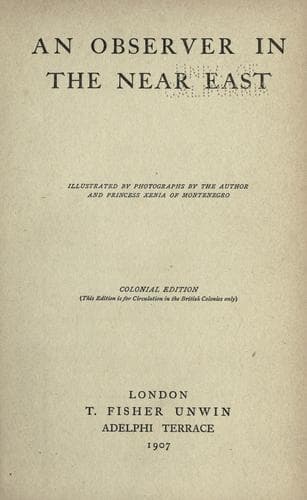
Balkan Peninsula -- Description and travel; Eastern question (Balkan)
Austria’s chief aim in Servia is to estrange the people from their King,
to create as much discord and discontent as possible to crush the trade
of the country and to keep her poor. As long as she believed that Servia
was in a bad position economically and financially, things were allowed
to go from bad to worse. But as soon as an improvement was observed in
the national prosperity, a hostile policy was adopted, which has
rendered trade between the two countries impossible.
Careful inquiries of the Servian Cabinet Ministers and many statesmen of
both political parties show that even in the present position, with
Austria closed against her, Servia is nevertheless progressing, and
prospering more than the outside world ever dreams.
The last commercial treaty between Austria and Servia expired in 1904.
There was a desire on the part of Servia to at once renew it, but this
Austria-Hungary was unable to do, as she was rearranging her treaty with
Germany. When, however, the first negotiations were started, Austria
made very severe complaints regarding the Serbo-Bulgarian Customs Union,
and asked that the treaty in question should be annulled before
negotiations for the new treaty were started. The Servian Government,
desirous of pleasing Austria, replied that in the Serbo-Bulgarian
Customs Union there was a clause to the effect that if one of the Great
Powers raised a protest, amendments might be introduced. They therefore
suggested the postponement of this question, hoping that Austria was
satisfied, and would begin the _pourparlers_. But no such thing. Austria
had other aims, for very soon they coolly declared that if the
commercial treaty were renewed, Servia must buy her new armament for the
artillery of the Scoda works in Austria. This is peculiar, inasmuch as
the cannon in question is not that in use by the Austrian artillery!
The reason for this has been explained by the fact that certain members
of the Austrian Imperial family were financially interested in the works
in question. This, however, was not the real reason. There was one far
more subtle. The true political reason, indeed, was that the Austrian
Government wished to get a seat in the “Autonom-Monopol”
administration—the body which controls the loans, and which consists of
six members, namely, one French delegate, one German, and four Servians.
France and Germany were both friendly, but Austria, had she gained a
seat there, could at once have created internal dissension and
difficulty.
Nominally, the annual income from this “Monopol” is about thirty million
dinars, or francs, of which twenty million go to the creditors, leaving
ten million at the free disposal of the Government. Now had Austria
obtained a hand in this administration, she would have been able to
exercise a prerogative and a right of intervention in many matters
affecting the good government of the country—a danger that will at once
be apparent.
Public-domain text, read in full here on John Shaqi.
Reviews
Reviews
No reviews yet
Be the first to share your thoughts on this work.
Elsewhere in the archive
Join the Discussion
Join the discussion
Sign in to leave a comment or review.
Sign InorCreate an account