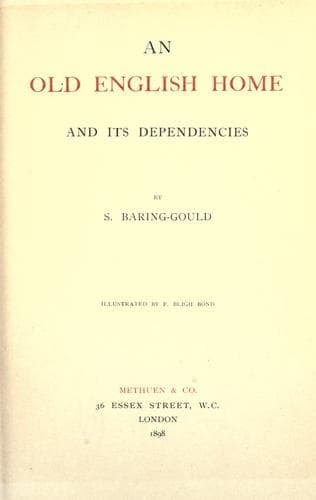
An Old English Home and Its DependenciesBaring-Gould, S. (Sabine)
History
An Old English Home and Its Dependencies
Baring-Gould, S. (Sabine)
England -- Social life and customs
How infinitely dreary is the landscape in France without hedges. The
eye ranges over a boundless plain of rolling land, that is divided
into strips of various colours like a plaid, and no trees are visible
except lines of trimmed poplars, or a scrubby wood kept for fuel.
The eye ranges over belts of cabbage and colza, potatoes, beetroot,
barley and lentils, wheat and sanfoin. There is not a single hedge
anywhere--no harbour for such plants as have not the stubbornness to
live on in spite of plough, and pick, and spade, and hoe. Flowers there
are--for flowers are obstinate and persist in coming--grape hyacinths,
star of Bethlehem, lungwort, scarlet anemones, tulips, blue-bottles,
cornflowers, salvia, and so on--because they dive out of reach of the
spade and share, or because they do not object to having their tubers
cut up--they rather like it. They multiply from every portion. But this
is not the case with all flowers. Some have too refined a nature, are
too frail, modest, reserved, to endure rough treatment. They ask only
to be let alone. They will die if incessantly worried--and for such
there is no other place of refuge available except the hedgerow.
I was the other day on the battlefield of Poitiers. The chroniclers
tell of the banks, the hedges and vineyard walls that stood in 1356,
and afforded shelter for the English archers. Not one remains. Every
hedge has been levelled, every mound spread, and with them have gone
all those flowers that once made the battlefield like a garden.
Our old English hedges are the Poor Man's conservatory, are the
playground of his children. How starred they are in spring with
primroses! How they flush with red robin! How they mantle with
bluebell! How they wave with foxglove! Talking of the latter, I was
driving one day in Cornwall, when my coachman pointed to a range of
foxgloves, and said: "Look there, sir! They are just like girls!"
"What do you mean?" I asked.
"Did you never notice," said he, "that the foxglove always turns its
flowers towards the road--it never looks into the hedge?"
"Naturally, no flower exists that does not look to the light."
"'Tain't that," said the driver. "'Tis they know they've got pretty
faces, and wants to show them."
Then, again, the ferns and the mosses! What a wealth of beauty in them!
What a variety! Not to be discovered in the field; only in their own
quarter, reserved for them--the hedgerow.
Our hedges are probably as ancient as our civilization. We know of
a few only that have been erected within the memory of man; the
majority have existed from the period when our land was first put into
cultivation. And it is remarkable that in the north of Germany, in
Westphalia, the Saxon region whence came our Teutonic ancestors, there
the hedge with which we are familiar in England is to be met with as
well, as an institution of the country, and a feature of the landscape.
Public-domain text, read in full here on John Shaqi.
Reviews
Reviews
No reviews yet
Be the first to share your thoughts on this work.
Elsewhere in the archive
Join the Discussion
Join the discussion
Sign in to leave a comment or review.
Sign InorCreate an account