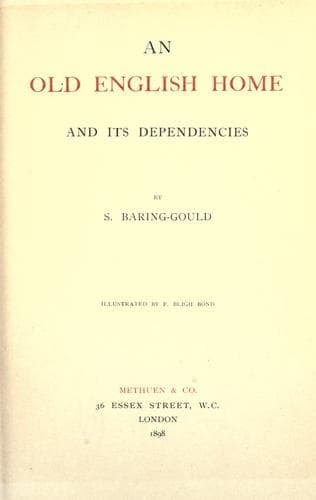
An Old English Home and Its DependenciesBaring-Gould, S. (Sabine)
History
An Old English Home and Its Dependencies
Baring-Gould, S. (Sabine)
England -- Social life and customs
"There's nothing going on in the old country. I'm off somewhere over
the seas again. Can't help it. I love dear old England, and blessed old
Cornwall above all, but if they won't or can't support me and my family
I must go elsewhere."
Alas! this is too true. The mines are nearly all shut down. In one
parish alone, that of Calstock, there were twenty-two in active
operation a few years ago, now not one.
The miners are scattered over the world. They are gone to South Africa,
to Brazil, to the Straits Settlements.
But where are no mines, there are quarries. Oh! the delightful hours
spent in boyhood in old quarries! In picking blackberries where the
brambles grow rank over the heaps of rubble and ripen their delicious
fruit against the crumbled stone that radiates the warmth of the sun!
In groping after fossils in the chalk quarries of the South Downs,
delighted in being able to extract a fossil sponge or a glistening
shark's tooth!
Nothing so unsightly as a new quarry, a wound in the face of nature,
yet nothing more picturesque than one which is old, all the scars
healed over by nature.
And then, again, what haunts old quarries are for rabbits--and
therefore also places in which boys delight to spend hours ferreting
Bunny.
In connexion with a quarry I will venture to tell a story--curious,
because showing a form of superstition not extinct. I tell the tale
my own way, but it is fundamentally true--that is to say, it is quite
true that the quarryman told it; and believed himself to have been
victimized in the way I relate, though I cannot vouch for the exact
words he employed.
I was examining for geological purposes a quarry in Cornwall that
had been opened in the side of a hill for the extraction of stone,
wherewith to metal the roads. Whilst studying the strata, I observed a
sort of nick in the uppermost layer of rock, under the earth which rose
above the surface of the rock some three feet six inches or four feet.
The nick was about two feet deep and the same breadth, and the sides
were cut perpendicularly. It was clearly artificial, and at once struck
me as being a section of a grave. There was no churchyard interfered
with, so that I supposed the grave was prehistoric, and at once
exclaimed to the quarryman engaged in the excavation that this was a
grave. He put down his pick, and answered:
"Yes, sir, it is a grave what you see here, and what is more I can tell
you whose grave it is, or was. And a coorious sarcumstance is connected
with that there grave, and if you don't mind sitting down on that piece
o' rock for five minutes, I'll tell you all about it."
Without paying much heed to the statement that the man made, that he
knew whose last resting-place it was, I inquired whether any flint or
bronze weapons had been found there.
"No, sir," said the quarryman, "nothing of the sort as far as I know;
it was the head of the grave we cut through, and when we sent the pick
into it, the gentleman's head came down into the quarry."
Public-domain text, read in full here on John Shaqi.
Reviews
Reviews
No reviews yet
Be the first to share your thoughts on this work.
Elsewhere in the archive
Join the Discussion
Join the discussion
Sign in to leave a comment or review.
Sign InorCreate an account