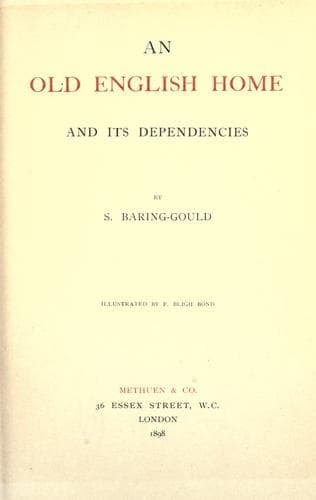
An Old English Home and Its DependenciesBaring-Gould, S. (Sabine)
History
An Old English Home and Its Dependencies
Baring-Gould, S. (Sabine)
England -- Social life and customs
Formerly exact uniformity in the way of thinking, speaking, dressing,
acting, was not insisted upon, and the village doctor was not
infrequently an oddity. He affected the oddity--to be a little rough
and domineering, he put on an acerbity of manner that belied his real
sweetness of temper, assumed a roughness at variance with his real
gentleness of heart. Those of us who have lived all our lives in
the country must look back with a smile rising to the lips, at the
recollection of the village doctors we have met and made acquaintance
with.
They could generally tell a good story. They were inveterate
gossips--knew all the ins and outs of all the families in every
grade of life within their beat, and though they kept professional
secrecy, were nothing loth to tell a tale, where not within the line
of professional responsibility. And they were such delightful humbugs,
also, veiling their ignorance so skilfully, with much explanation in
grandiose terms that meant nothing.
I remember an old village doctor who I really believe was absolutely
ignorant of all methods and medicines introduced since he walked the
hospitals, which was in the first decade of the present century.
I have looked through his medical library since his death, I have
seen his surgical apparatus, and have taken note of the drugs in his
pharmacopoea, and I am quite sure that his medicinal education came
to an abrupt stop about the year 1815.
He was a popular doctor, enjoyed a great reputation in his
neighbourhood, maintained a large family of unmarriageable daughters,
and lived in comfort in a cosy cottage embowered in elms, with its
pleasant garden full of old-fashioned flowers.
This old gentleman's method, on being sent for, was at once to take
a gloomy view of the case. "My dear fellow," he would say to the
patient, "this is a very aggravated malady. _I ought to have been sent
for before._ If you die, it is your own fault. _I ought to have been
sent for before._ A stitch in time saves nine. If now, by a desperate
struggle, I pull you through, then it will teach you a lesson in future
not to delay sending for me till the time is almost over at which
medical assistance can avail. _I ought to have been sent for before._"
The advantage of such an address was this. If the sick person dropped
through his hands, the responsibility was thrown on the sick man and
his friends. If, however, he were to recover, then it exalted the skill
of the medical practitioner to almost miraculous power.
Public-domain text, read in full here on John Shaqi.
Reviews
Reviews
No reviews yet
Be the first to share your thoughts on this work.
Elsewhere in the archive
Join the Discussion
Join the discussion
Sign in to leave a comment or review.
Sign InorCreate an account