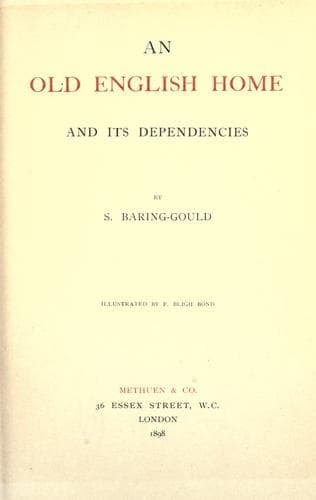
An Old English Home and Its DependenciesBaring-Gould, S. (Sabine)
History
An Old English Home and Its Dependencies
Baring-Gould, S. (Sabine)
England -- Social life and customs
But the village surgeon had not in old days the skilled nurse as his
assistant: and it is now a recognized truth that, for the sick, the
nurse is more important than the doctor. He sent his medicines, but how
could he be sure that they were taken, or taken regularly? The whole
system of nursing was as rude as the whole system of drainage. It was
all happy-go-lucky. The story is well known of the doctor sending a
bottle of mixture to a sick man, with the direction on it, "Before
taken to be well shaken"--and finding on his arrival that the attendant
had shaken up the patient pretty vigorously before administering the
draught.
The following story is perfectly true.
A kind-hearted village doctor, finding that a poor woman he was
attending needed nourishing food, got his wife to send her a jelly.
Some time after he went to the cottage, found the ground-floor room
untenanted, but heard a trampling, groaning, and struggling going on
upstairs. He accordingly ascended to the bedroom, to see a labouring
man sitting on the bed, holding up the sick woman's head, whilst
another labouring man--her husband--was standing on the bed, one foot
on each side of the patient, with a black kitchen kettle in his hand,
endeavouring to pour the contents down her mouth. Both men were hot and
perspiring freely, and the poor woman was gasping for breath and almost
expiring under the treatment.
"Good gracious!" exclaimed the doctor, "what are you about?"
"Please, sir," answered the husband, blowing hard, and wiping his brow
with his sleeve, "us've been giving her the medicine you sent down. It
got all stiff and hard, so we clapped it into the kettle and gave it
a bile, and was pouring it down my wife's throat. I couldn't hold her
mouth open myself as well as mind the kettle, so I just called in my
mate Thomas, to help and hold her up, and open her mouth for the kettle
spout."
The life of the village doctor is a hard one. Never certain of a meal,
and never certain of a sound, undisturbed sleep, he has to take his
victuals and his rest by snatches, but then he inhales the fresh, pure
air, and that maintains him in health. He has to keep his natural
weakness and natural impatience under great control. Conceive of a man
who has had several broken nights and hard days' work, with a head
swimming with weariness, called in to a critical case, that he has to
diagnose at once. His faculties are not on the alert, they cannot be,
and if he make a mistake, an avalanche of abuse is poured down on him,
whereas the fault lies not in himself, but in the circumstances.
Then, again, how vexatious, when tired out and hungry, to be suddenly
called away for a drive of many miles--perhaps over the very road
he has just returned along--to see a _malade imaginaire_, some
hypocondriacal old maid, who is best dosed with a bread pill, or
to attend to some pet child--whose only complaint is that it has
over-eaten itself, and who is well again by the time the doctor arrives.
Public-domain text, read in full here on John Shaqi.
Reviews
Reviews
No reviews yet
Be the first to share your thoughts on this work.
Elsewhere in the archive
Join the Discussion
Join the discussion
Sign in to leave a comment or review.
Sign InorCreate an account