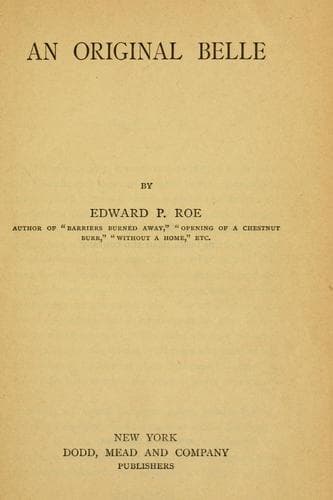
Love stories; United States -- History -- Civil War, 1861-1865 -- Fiction
THE month of September, 1862, was a period of strong excitement
and profound anxiety on both sides of the vague and shifting line
which divided the loyal North from the misguided but courageous
South. During the latter part of August Gen. Pope had been
overwhelmed with disaster, and what was left of his heroic army
was driven within the fortifications erected for the defence of
Washington. Apparently the South had unbounded cause for exultation.
But a few weeks before their capital had been besieged by an immense
army, while a little to the north, upon the Rappahannock, rested
another Union army which, under a leader like Stonewall Jackson,
would have been formidable enough in itself to tax Lee's skill and
strength to the utmost. Except in the immediate vicinity of the
capital and Fortress Monroe scarcely a National soldier had been
left in Virginia. The Confederates might proudly claim that the
generalship of Lee and the audacity of Jackson had swept the Northern
invaders from the State.
Even more important than the prestige and glory won was the fact
that the Virginian farmers were permitted to gather their crops
unmolested. The rich harvests of the Shenandoah Valley and other
regions, that had been and should have been occupied by National
troops, were allowed to replenish the Confederate granaries. There
were rejoicings and renewed confidence in Southern homes, and smiles
of triumph on the faces of sympathizers abroad and throughout the
North.
But the astute leaders of the Rebellion were well aware that the
end had not yet come, and that, unless some bold, paralyzing blow
was struck, the struggle was but fairly begun. In response to the
request for more men new armies were springing up at the North. The
continent shook under the tread of hosts mustering with the stern
purpose that the old flag should cover every inch of the heritage
left by our fathers.
Therefore, Lee was not permitted to remain on the defensive a moment,
but was ordered to cross the Potomac in the rear of Washington,
threatening that city and Baltimore. It was supposed that the advent
of a Southern army into Maryland would create such an enthusiastic
uprising that thinned ranks would be recruited, and the State
brought into close relation with the Confederate Government. These
expectations were not realized. The majority sympathized with
Barbara Frietchie,
"Bravest of all in Frederick town,"
rather than with their self-styled deliverers; and Lee lost more
by desertion from his own ranks than he gained in volunteers. In
this same town of Frederick, by strange carelessness on the part
of the rebels, was left an order which revealed to McClellan Lee's
plans and the positions which his divided army were to occupy during
the next few days. Rarely has history recorded such opportunities
as were thus accidentally given to the Union commander.
Public-domain text, read in full here on John Shaqi.
Reviews
Reviews
No reviews yet
Be the first to share your thoughts on this work.
Elsewhere in the archive
Join the Discussion
Join the discussion
Sign in to leave a comment or review.
Sign InorCreate an account