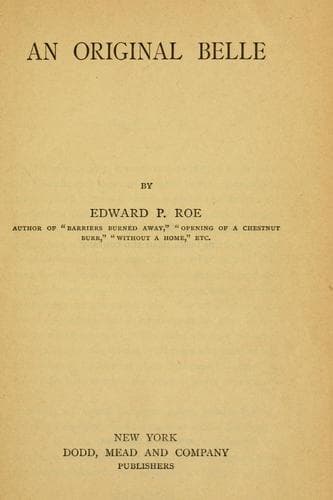
Love stories; United States -- History -- Civil War, 1861-1865 -- Fiction
"Come down to the present hour, then. What he asked of you is one
thing. I see what he wishes. He desires, at least, the friendship
that I give to those who fulfil my ideal of manhood in these times.
He has no right to seek this without meeting the conditions which
remove all hesitation in regard to others. It angers me that he does
so. I feel as if he were seeking to buy my good-will by donations
to this, that, and the other thing. He still misunderstands me.
Why can't he realize that, to one of my nature, fording the icy
Rappahannock to-night would count for more than his writing checks
for millions?"
"Probably he does understand it, and that is what he meant by
his words to-night, when he said, 'What is this storm, or what a
battle?'"
She was overwrought, excited, and off her guard, and spoke from a
deep impulse. "A woman, in giving herself, gives everything. If he
can't give up a scruple--I mean if his loyalty is so slight that
his mother's wishes and dead ancestors--"
"My dear little girl, you are not under the slightest obligation
to give anything," resumed her father, discreetly oblivious to the
significance of her words. "If you care to give a little good-will
and kindness to one whom you have granted the right to visit you,
they will tend to confirm and develop the better and manly qualities
he is now manifesting. You know I have peculiar faculties of finding
out about people, and, incidentally and casually, I have informed
myself about this Mr. Merwyn. I think I can truly say that he is
doing all and more than could be expected of a young fellow in his
circumstances, with the one exception that he does not put on our
uniform and go to the front. He may have reasons--very possibly, as
you think, mistaken and inadequate ones--which, nevertheless, are
binding on his conscience. What else could his words mean to-night?
He is not living a life of pleasure-seeking and dissipation, like so
many other young nabobs in the city. Apparently he has not sought
much other society than yours. Pardon me for saying it, but you
have not given him much encouragement to avoid the temptations that
are likely to assail a lonely, irresponsible young fellow. In one
sense you are under no obligation to do this; in another, perhaps
you are, for you must face the fact that you have great influence
over him. This influence you must either use or throw away, as
you decide. You are not responsible for this influence; neither are
your friends responsible for the war. When it came, however, they
faced the disagreeable and dangerous duties that it brought."
"O papa! I have been a stupid, resentful fool."
Public-domain text, read in full here on John Shaqi.
Reviews
Reviews
No reviews yet
Be the first to share your thoughts on this work.
Elsewhere in the archive
Join the Discussion
Join the discussion
Sign in to leave a comment or review.
Sign InorCreate an account