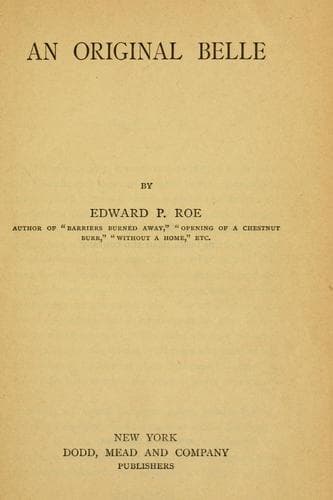
Love stories; United States -- History -- Civil War, 1861-1865 -- Fiction
will not give my hand, even in friendship, to a man who would do
less than I would, were I in his place."
If her father was right, and he had scruples of conscience, or some
other unknown restraint, she felt that she must know all before
she would give her trust and more. If he could not satisfy her on
these points, as others had done so freely and spontaneously, he
had no right to ask or expect more from her than ordinary courtesy.
Having thus resolutely considered antidotes for a tendency towards
relentings not at all to her mind, and met, as she believed, her
father's charge of unfairness, her thoughts, full of sympathy and
hope, dwelt upon the condition of her friend. Recalling the past
and the present, her heart grew very tender, and she found that he
occupied in it a foremost place. Indeed, it seemed to her a species
of disloyalty to permit any one to approach his place and that of
Mr. Lane, for both formed an inseparable part of her new and more
earnest life.
She, too, had changed, and was changing. As her nature deepened and
grew stronger it was susceptible of deeper and stronger influences.
Under the old regime pleasure, excitement, triumphs of power that
ministered to vanity, had been her superficial motives. To the degree
that she had now attained true womanhood, the influences that act
upon and control a woman were in the ascendant. Love ceased to dwell
in her mind as a mere fastidious preference, nor could marriage
ever be a calculating choice, made with the view of securing the
greatest advantages. She knew that earnest men loved her without a
thought of calculation,--loved her for herself alone. She called
them friends now, and to her they were no more as yet. But their
downright sincerity made her sincere and thoughtful. Her esteem and
affection for them were so great that she was not at all certain
that circumstances and fuller acquaintance might not develop her
regard towards one or the other of them into a far deeper feeling.
In their absence, their manly qualities appealed to her imagination.
She had reached a stage in spiritual development where her woman's
nature was ready for its supreme requirement. She could be more
than friend, and was conscious of the truth; and she believed that
her heart would make a positive and final choice in accord with
her intense and loyal sympathies. In the great drama of the war
centred all that ideal and knightly action that has ever been so
fascinating to her sex, and daily conversation with her father had
enabled her to understand what lofty principles and great destinies
were involved. She had been shown how President Lincoln's proclamation,
freeing the slaves, had aimed a fatal blow at the chief enemies
of liberty, not only in this land, but in all lands. Mr. Vosburgh
was a philosophical student of history, and, now that she had become
his companion, he made it clear to her how the present was linked
to the past. Instead of being imbued with vindictiveness towards
Public-domain text, read in full here on John Shaqi.
Reviews
Reviews
No reviews yet
Be the first to share your thoughts on this work.
Elsewhere in the archive
Join the Discussion
Join the discussion
Sign in to leave a comment or review.
Sign InorCreate an account