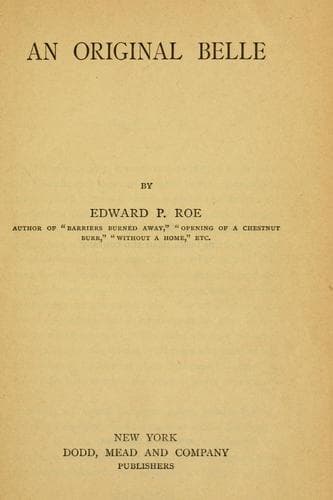
Love stories; United States -- History -- Civil War, 1861-1865 -- Fiction
"They are neither good nor satisfactory," burst out the young man
with sudden and vindictive impetuosity. "They are the curse of my
life. Pardon me. I am forgetting myself. I believe you are friendly
at least. Please let all this be as if it were not." Then, as if
the possible import of his utterance had flashed upon him, he drew
himself up and said, coldly, "If, under the circumstances, you feel
I am unworthy of trust--"
"Mr. Merwyn," interrupted his host, "I am accustomed to deal with
men and to be vigilantly on my guard. My words led to what has
passed between us, and it ends here and now. I would not give you
my hand did I not trust you. Come, here is the book;" and he led
the way to a conversation relating to it.
Merwyn did his best to show a natural interest in the subject, but
it was evident that a tumult had been raised in his mind difficult
to control. At last he said: "May I take the book home? I will
return it after careful reading."
Mr. Vosburgh accompanied him to the drawing-room, and Marian
sportively introduced him to Major Strahan.
For a few minutes he was the gayest and most brilliant member of
the party, and then he took his leave, the young girl remarking,
"Since you have a book under your arm we cannot hope to detain you,
for I have observed that, with your true antiquarian, the longer
people have been dead the more interesting they become."
"That is perfectly natural," he replied, "for we can form all sorts
of opinions about them, and they can never prove that we are wrong."
"More's the pity, if we are wrong. Good-night."
"Order an extra chop, Merwyn, and I'll breakfast with you," cried
Strahan. "I've only two days more, you know."
"Well, papa," said Marian, joining him later in the library, "did
you and Mr. Merwyn settle the precise date when the Dutch took
Holland?"
"'More's the pity, if we ARE wrong!' I have been applying your
words to the living rather than to the dead."
"To Mr. Merwyn, you mean."
"Yes."
"Has he been unbosoming himself to you?"
"Oh, no, indeed!"
"Why then has he so awakened your sympathy?"
"I fear he is facing more than any of your friends."
"And, possibly, fear is the reason."
"I do not think so."
"It appears strange to me, papa, that you are more ready to trust
than I am. If there is nothing which will not bear the light, why
is he so reticent even to his friend?"
"I do not know the reasons for his course, nor am I sure that they
would seem good ones to me, but my knowledge of human nature is
at fault if he is not trustworthy. I wish we did know what burdens
his mind and trammels his action. Since we do not I will admit,
to-night, that I am glad you feel toward him just as you do."
"Papa, you entertain doubts at last."
"No, I admit that something of importance is unknown and bids fair
to remain so, but I cannot help feeling that it is something for
which he is not to blame. Nevertheless, I would have you take no
steps in the dark, were the whole city his."
Public-domain text, read in full here on John Shaqi.
Reviews
Reviews
No reviews yet
Be the first to share your thoughts on this work.
Elsewhere in the archive
Join the Discussion
Join the discussion
Sign in to leave a comment or review.
Sign InorCreate an account