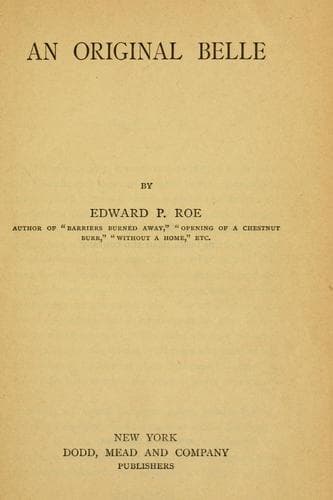
Love stories; United States -- History -- Civil War, 1861-1865 -- Fiction
IN due time Strahan departed, hopeful and eager to enter on the
duties pertaining to his higher rank. He felt that Marian's farewell
had been more than she had ever given him any right to expect.
Her manner had ever been too frank and friendly to awaken delusive
hopes, and, after all, his regard for her was characterized more
by boyish adoration than by the deep passion of manhood. To his
sanguine spirit the excitement of camp and the responsibilities of
his new position formed attractions which took all poignant regret
from his leave-taking, and she was glad to recognize this truth.
She had failed signally to carry out her self-sacrificing impulse,
when he was so ill, to reward his heroism and supplement his life
with her own; and she was much relieved to find that he appeared
satisfied with the friendship she gave, and that there was no
need of giving more. Indeed, he made it very clear that he was not
a patriotic martyr in returning to the front, and his accounts of
army life had shown that the semi-humorous journal, kept by himself
and Blauvelt, was not altogether a generous effort to conceal from
her a condition of dreary duty, hardship, and danger. Life in the
field has ever had its fascinations to the masculine nature, and
her friends were apparently finding an average enjoyment equal
to her own. She liked them all the better for this, since, to her
mind, it proved that that the knightly impulses of the past were
unspent,--that, latent in the breasts of those who had seemed mere
society fellows, dwelt the old virile forces.
"I shall prove," she assured herself, proudly, "that since true men
are the same now as when they almost lived in armor, so ladies in
their bowers have favors only for those to whom heroic action is
second nature."
Blauvelt had maintained the journal during Strahan's absence, doing
more with pencil than pen, and she had rewarded him abundantly
by spicy little notes, full of cheer and appreciation. She had
no scruples in maintaining this correspondence, for in it she had
her father's sanction, and the letters were open to her parents'
inspection when they cared to see them. Indeed, Mr. and Mrs.
Vosburgh enjoyed the journal almost as much as Marian herself.
After Strahan's departure, life was unusually quiet in the young
girl's home. Her father was busy, as usual, and at times anxious,
for he was surrounded by elements hostile to the government. Aware,
however, that the army of the Potomac was being largely reinforced,
that General Hooker was reorganizing it with great success, and
that he was infusing into it his own sanguine spirit, Mr. Vosburgh
grew hopeful that, with more genial skies and firmer roads, a blow
would be struck which would intimidate disloyalty at the North as
well as in the South.
Marian shared in this hopefulness, although she dreaded to think
how much this blow might cost her, as well as tens of thousands of
other anxious hearts.
Public-domain text, read in full here on John Shaqi.
Reviews
Reviews
No reviews yet
Be the first to share your thoughts on this work.
Elsewhere in the archive
Join the Discussion
Join the discussion
Sign in to leave a comment or review.
Sign InorCreate an account