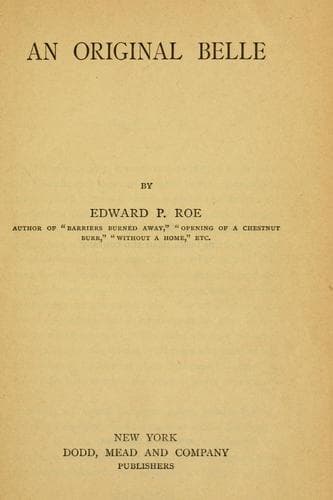
Love stories; United States -- History -- Civil War, 1861-1865 -- Fiction
The month of May was passing in mocking beauty to those whose hopes
and happiness were bound up in the success of the Union armies. Not
only had deadly war depleted Hooker's grand army, but the expiration
of enlistments would take away nearly thirty thousand more. Mr.
Vosburgh was aware of this, and he also found the disloyal elements
by which he was surrounded passing into every form of hostile
activity possible within the bounds of safety. Men were beginning to
talk of peace, at any cost, openly, and he knew that the Southern
leaders were hoping for the beginning at any time of a counter-revolution
at the North. The city was full of threatening rumors, intrigues,
and smouldering rebellion.
Marian saw her father overwhelmed with labors and anxieties, and
letters from her friends reflected the bitterness then felt by the
army because the North appeared so half-hearted.
"Mr. Merwyn, meanwhile," she thought, "is interesting himself in
landscape-gardening. If he has one spark of manhood or courage he
will show it now."
The object of this reproach was living almost the life of a hermit
at his country place, finding no better resource, in his desperate
unrest and trouble, than long mountain rambles, which brought
physical exhaustion and sleep.
He had not misunderstood Marian's final words and manner. Delicately,
yet clearly, she had indicated the steps he must take to vindicate
his character and win her friendship. He felt that he had become
pale, that he had trembled in her presence. What but cowardice
could explain his manner and account for his inability to confirm
the good impression he had made by following the example of her
other friends? From both his parents he had inherited a nature
sensitive to the last degree to any imputation of this kind. To
receive it from the girl he loved was a hundred-fold more bitter
than death, yet he was bound by fetters which, though unseen by
all, were eating into his very soul. The proud Mrs. Merwyn was a
slave-holder herself, and the daughter of a long line of slave-owners;
but never had a bondsman been so chained and crushed as was her
son. For weeks he felt that he could not mingle with other men,
much less meet the girl to whom manly courage was the corner-stone
of character.
One evening in the latter part of May, as Mr. Vosburgh and his
family were sitting down to dinner, Barney Ghegan, the policeman,
appeared at their door with a decent-looking, elderly colored
woman and her lame son. They were refugees, or "contrabands," as
they were then called, from the South, and they bore a letter from
Captain Lane.
It was a scrap of paper with the following lines pencilled upon
it:--
"MR. VOSBURGH, No. -- -- ST.: I have only time for a line. Mammy
Borden will tell you her story and that of her son. Their action
and other circumstances have enlisted my interest. Provide them
employment, if convenient. At any rate, please see that they want
nothing, and draw on me. Sincere regard to you all.--In haste,
Public-domain text, read in full here on John Shaqi.
Reviews
Reviews
No reviews yet
Be the first to share your thoughts on this work.
Elsewhere in the archive
Join the Discussion
Join the discussion
Sign in to leave a comment or review.
Sign InorCreate an account