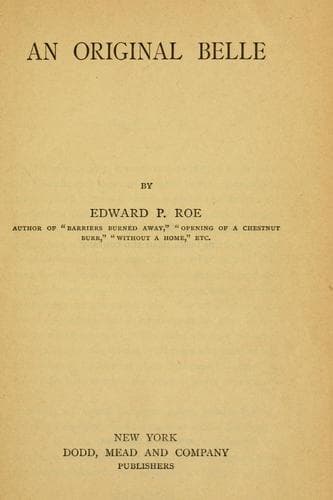
Love stories; United States -- History -- Civil War, 1861-1865 -- Fiction
For the last few days the spirit of rebellion had been burning like
a fuse toward a vast magazine of human passion and intense hatred
of Northern measures and principles. If from Pennsylvania had come
in electric flash the words, "Meade defeated," the explosion would
have come almost instantly; but all now had learned that the army
of the Potomac had emerged from its obscurity, and had grappled
with the invading forces. Even the most reckless of the so-called
peace faction could afford to wait a few hours longer. As soon as
the shattered columns of Meade's army were in full retreat, the
Northern wing of the rebellion could act with confidence.
The Tribune, in commenting on the incendiary document distributed
on the evening of the 3d, spoke as follows: "That the more determined
sympathizers, in this vicinity, with the Southern rebels have, for
months, conspired and plotted to bring about a revolution is as
certain as the Civil War. Had Meade been defeated," etc.
The dramatic culmination of this awful hour of uncertainty may
be found in the speeches, on July 4th, of ex-President Franklin
Pierce, at Concord, N.H., and of Governor Seymour, in the Academy
of Music, at New York. The former spoke of "the mailed hand of
military usurpation in the North, striking down the liberties of
the people and trampling its foot on a desecrated Constitution."
He lauded Vallandigham, who was sent South for disloyalty, as "the
noble martyr of free speech." He declared the war to be fruitless,
and exclaimed: "You will take care of yourselves. With or without
arms, with or without leaders, we will at least, in the effort to
defend our rights, as a free people, build up a great mausoleum of
hearts, to which men who yearn for liberty will, in after years,
with bowed heads reverently resort as Christian pilgrims to the
shrines of the Holy Land."
Such were the shrines with which this man would have filled New
England. There is a better chance now, that a new and loyal Virginia
will some day build a monument to John Brown.
Governor Seymour's speech was similar in tenor, but more guarded.
In words of bitter irony toward the struggling government, whose
hands the peace faction were striving to paralyze, he began: "When
I accepted the invitation to speak with others, at this meeting,
we were promised the downfall of Vicksburg, the opening of the
Mississippi, the probable capture of the Confederate capital, and
the exhaustion of the rebellion. By common consent, all parties
had fixed upon this day when the results of the campaign should be
known. But, in the moment of expected victory, there came a midnight
cry for help from Pennsylvania, to save its despoiled fields from
the invading foe; and, almost within sight of this metropolis, the
ships of your merchants were burned to the water's edge. Parties
are exasperated and stand in almost defiant attitude toward each
other."
Public-domain text, read in full here on John Shaqi.
Reviews
Reviews
No reviews yet
Be the first to share your thoughts on this work.
Elsewhere in the archive
Join the Discussion
Join the discussion
Sign in to leave a comment or review.
Sign InorCreate an account