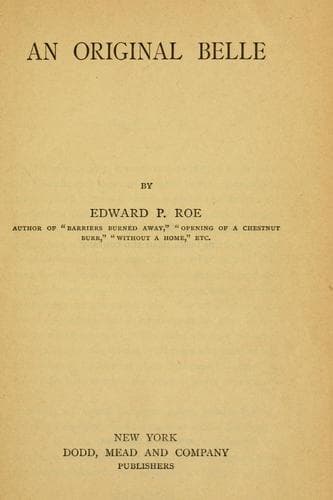
Love stories; United States -- History -- Civil War, 1861-1865 -- Fiction
"Now," she resumed, laughing, "I've found out that the 'good angel'
is not treating you as well as the common soldiers. Men always let
out the truth sooner or later. If Surgeon McAllister will permit,
I'll read and talk to you also."
"I not only give my permission," said the surgeon, "but also assure
you that such kindness will hasten the captain's recovery, for time
hangs so heavily on his hands that he chafes and worries."
"Very well," with a sprightly nod at the surgeon, "since we've
undertaken to cure the captain, the most sensible thing for us to
do IS to cure him. You shall prescribe when and how the doses of
society are to be administered." Then to Lane, "Not another word;
good-night;" and in a moment she was gone.
Suwanee never forgot that interview, for it was the beginning
of a new and strange experience to her. From the first, her high,
chivalric spirit had been compelled to admire her enemy. The unknown
manner in which he had foiled her sister's strategy showed that
his mind was equal to his courage, while his hot indignation, when
he found them threatened by a midnight marauder, had revealed his
nature. Circumstances had swiftly disarmed her prejudices, and her
warm heart had been full of sympathy for him as he lay close to
the borders of death. All these things tended to throw down the
barriers which would naturally interpose between herself and a
Northern man. When, therefore, out of a full heart, he revealed
his gratitude and homage, she had no shield against the force of
his words and manner, and was deeply touched. She had often received
gallantry, admiration, and even words of love, but never before had
a man looked and acted as if he reverenced her and the womanhood
she represented. It was not a compliment that had been bestowed,
but a recognition of what she herself had not suspected. By her
family or acquaintances she had never been thought or spoken of as
an especially good girl. Hoydenish in early girlhood, leading the
young Southern gallants a chase in later years, ever full of frolic
and mischief, as fond of the dance as a bird of flying, she was
liked by every one, but the graver members of the community were
accustomed to shake their heads and remark, "She is a case; perhaps
she'll sober down some day." She had hailed the war with enthusiasm,
knowing little of its meaning, and sharing abundantly in rural
Virginia's contempt for the North. She had proved even a better
recruiting officer than her stately sister, and no young fellow
dared to approach her until he had donned the gray. When the war
came she met it with her own laughing philosophy and unconquerable
buoyancy, going wild over Southern victories and shrugging her plump
shoulders over defeats, crying: "Better luck next time. The Yankees
probably had a hundred to one. It won't take long for Southerners
to teach Northern abolitionists the difference between us." But
now she had seen Northern soldiers in conflict, had witnessed the
Public-domain text, read in full here on John Shaqi.
Reviews
Reviews
No reviews yet
Be the first to share your thoughts on this work.
Elsewhere in the archive
Join the Discussion
Join the discussion
Sign in to leave a comment or review.
Sign InorCreate an account