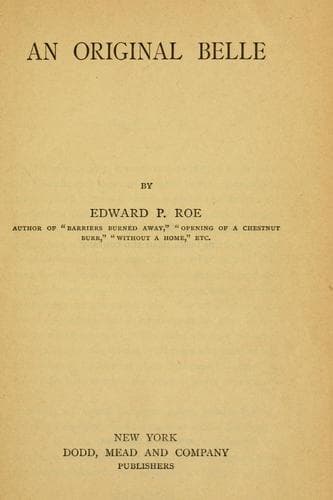
Love stories; United States -- History -- Civil War, 1861-1865 -- Fiction
The fact of the prisoners' escape soon became evident, and there
were haste, confusion, and running to and fro to no purpose. Suwanee
imitated Roberta so closely that she was not suspected. Lieutenant
Macklin and the rebel sergeant at last returned, giving evidence
of strong vexation.
"We don't understand this," began the lieutenant.
"Neither do we," interrupted Mrs. Barkdale, so haughtily that they
were abashed, although they directed keen glances towards Suwanee,
who met their scrutiny unflinchingly.
The Barkdales were not people to be offended with impunity, and the
lieutenant knew it. He added, apologetically: "You know I must do
my duty, madam. I fear some of your servants are implicated, or
that guards have been tampered with."
"You are at liberty to examine any one you please."
They might as well have examined a carved, wrinkled effigy as old
Cuffy, Lane's midnight guide. "I don' know nuffin' 'tall 'bout it,"
he declared. "My ole woman kin tell yo' dat I went to bed when she
did and got up when she did."
The guard, bought with kindness, was as dense in his ignorance as
any of the others. At last Macklin declared that he would have to
put citizens on the hunt, for his orders admitted of no delay.
The Union prisoners, together with the Confederates, when formed
in line, gave a ringing cheer for "Missy S'wanee and the ladies,"
and then the old mansion was left in more than its former isolation,
and, as the younger girl felt, desolation.
She attended to her duties as usual, and then went to her piano.
The words spoken the previous evening would ever make the place
dear to her. While she was there old Hildy crept in, with her feeble
step, and whispered, "I foun' dis un'er Cap'n Lane's piller."
It was but a scrap of paper, unaddressed; but Suwanee understood
its significance. It contained these words: "I can never repay you,
but to discover some coin which a nature like yours can accept has
become one of my supreme ambitions. If I live, we shall meet again."
Those words formed a glimmering hope which grew fainter and fainter
in the dark years which followed.
She did not have to mask her trouble very long, for another sorrow
came like an avalanche. Close to the Union lines, on Cemetery Ridge,
lay a white-haired colonel and his two tall sons. They were among
the heroes in Pickett's final charge, on the 3d of July. "Missy
S'wanee" laughed no more, even in self-defence.
CHAPTER XLI.
SUNDAY'S LULL AND MONDAY'S STORM.
SUNDAY, the 12th of July, proved a long, restful sabbath to Marian
and her father, and they spent most of its hours together. The
great tension and strain of the past weeks appeared to be over for
a time. The magnificent Union victories had brought gladness and
hopefulness to Mr. Vosburgh, and the return of her friends had
relieved his daughter's mind. He now thought he saw the end clearly.
He believed that hereafter the tide of rebellion would ebb southward
until all the land should be free.
Public-domain text, read in full here on John Shaqi.
Reviews
Reviews
No reviews yet
Be the first to share your thoughts on this work.
Elsewhere in the archive
Join the Discussion
Join the discussion
Sign in to leave a comment or review.
Sign InorCreate an account