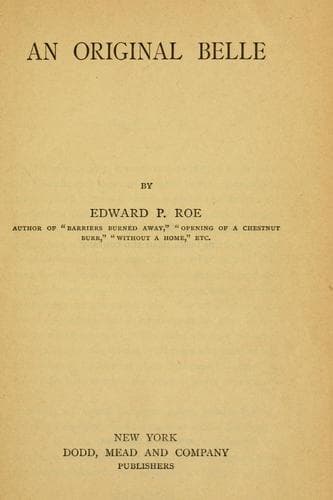
Love stories; United States -- History -- Civil War, 1861-1865 -- Fiction
An early horseback ride in Central Park had become one of Merwyn's
habits of late. At that hour he met comparatively few abroad, and
the desire for solitude was growing upon him. Like Mr. Vosburgh,
he had watched with solicitude the beginning of the draft, feeling
that if it passed quietly his only remaining chance would be to
wring from his mother some form of release from his oath. Indeed,
so unhappy and desperate was he becoming that he had thought
of revealing everything to Mr. Vosburgh. The government officer,
however, might feel it his duty to use the knowledge, should there
come a time when the authorities proceeded against the property
of the disloyal. Moreover, the young man felt that it would be
dishonorable to reveal the secret.
Beyond his loyal impulses he now had little motive for effort.
Marian's prejudices against him had become too deeply rooted, and
her woman's honor for the knightly men her friends had proved too
controlling a principle, ever to give him a chance for anything
better than polite tolerance. He had discovered what this meant
so fully, and in Blauvelt's story had been shown the inevitable
contrast which she must draw so vividly, that he had decided:--
"No more of Marian Vosburgh's society until all is changed. Therefore
no more forever, probably. If my mother proves as obdurate as a
Southern jailer, I suppose I'm held, although I begin to think I
have as good cause to break my chains as any other Union man. She
tricked me into captivity, and holds me remorselessly,--not like a
mother. Miss Vosburgh did show she had a woman's heart, and would
have given me her hand in friendship had I not been compelled to
make her believe that I was a coward. If in some way I can escape
my oath, and my reckless courage at the front proves her mistaken,
I may return to her. Otherwise it is a useless humiliation and pain
to see her any more."
Such had been the nature of his musings throughout the long Sunday
whose quiet had led to the belief that the draft would scarcely create
a ripple of overt hostility. During his ride on Monday morning he
nearly concluded to go to his country place again. He was growing
nervous and restless, and he longed for the steadying influence
of his mountain rambles before meeting his mother and deciding
questions which would involve all their future relations.
As with bowed head, lost in thought, he approached the city by
one of the park entrances, he heard a deep, angry murmur, as if
a storm-vexed tide was coming in. Spurring his horse forward, he
soon discovered, with a feeling like an electric shock, that a tide
was indeed rising. Was it a temporary tidal wave of human passion,
mysterious in its origin, soon to subside, leaving such wreckage
as its senseless fury might have caused? Or was it the beginning
of the revolution so long feared, but not now guarded against?
Public-domain text, read in full here on John Shaqi.
Reviews
Reviews
No reviews yet
Be the first to share your thoughts on this work.
Elsewhere in the archive
Join the Discussion
Join the discussion
Sign in to leave a comment or review.
Sign InorCreate an account