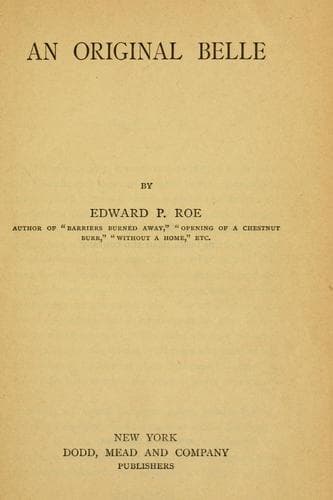
Love stories; United States -- History -- Civil War, 1861-1865 -- Fiction
Hastily disguising himself as he had done before, he again summoned
his faithful servant. This man's vigilance had enabled him to
admit his master instantly the night before. Beyond the assurance
that all was well and safe Merwyn had not then listened to a word,
yielding to the imperative craving for sleep and rest. These,
with youth and the vigor of a strong, unvitiated constitution, had
restored him wonderfully, and he was eager to enter on the perils
and duties of the new day. His valet and man-of-all-work told him
that he had been at pains to give the impression that the family
was away and the house partially dismantled.
"It wouldn't pay ye," he had said to a band of plunderers, "to bother
with the loikes of this house when there's plenty all furnished."
With injunctions to maintain his vigilance and not to be surprised
if Merwyn's absence was prolonged, the young man hastened away,
paving no heed to entreaties to remain and avoid risks.
It was still early, but the uneasy city was waking, and the streets
were filling with all descriptions of people. Thousands were
escaping to the country; thousands more were standing in their doors
or moving about, seeking to satisfy their curiosity; while in the
disaffected districts on the east and the west side the hosts of
the mob were swarming forth for the renewal of the conflict, now
inspired chiefly by the hope of plunder. Disquiet, anxiety, fear,
anger, and recklessness characterized different faces, according
to the nature of their possessors; but as a rule even the most
desperate of the rioters were singularly quiet except when under
the dominion of some immediate and exciting influence.
In order to save time, Merwyn had again hired a hack, and, seated
with the driver, he proceeded rapidly, first towards the East
River, and then, on another street, towards the Hudson. His eyes,
already experienced, saw on every side the promise of another bloody
day. He was stopped and threatened several times, for the rioters
were growing suspicious, fully aware that detectives were among
them, but he always succeeded in giving some plausible excuse. At
last, returning from the west side, the driver refused to carry
him any longer, and gave evidence of sympathy with the mob.
Merwyn quietly showed him the butt of a revolver, and said, "You
will drive till I dismiss you."
The man yielded sullenly, and Merwyn alighted near Mr. Vosburgh's
residence, saying to his Jehu, "Your course lies there," pointing
east,--and he rapidly turned a corner.
As Merwyn had surmised, the man wheeled his horses with the purpose
of following and learning his destination. Observing this eager
quest he sprung out upon him from a doorway and said, "If you try
that again I'll shoot you as I would a dog." The fellow now took
counsel of discretion.
Going round the block to make sure he was not observed, Merwyn
reached the residence of Mr. Vosburgh just as that gentleman was
rising from his breakfast, and received a cordial welcome.
Public-domain text, read in full here on John Shaqi.
Reviews
Reviews
No reviews yet
Be the first to share your thoughts on this work.
Elsewhere in the archive
Join the Discussion
Join the discussion
Sign in to leave a comment or review.
Sign InorCreate an account