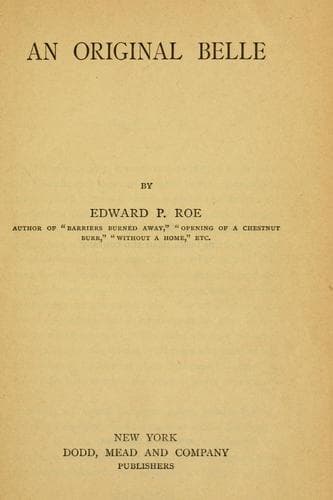
Love stories; United States -- History -- Civil War, 1861-1865 -- Fiction
By the time they reached the factory so many of the mob had
been killed or wounded, and so many of their leaders were dead or
disabled, that it again yielded to panic and fled. One desperate
leader, although already bruised and bleeding, had for a time
inspired the mob with much of his own reckless fury, and was left
almost alone by his fleeing companions. His courage, which should have
been displayed in a better cause, cost him dear, for a tremendous
blow sent him reeling against a fence, the sharp point of one of
the iron pickets caught under his chin, and he hung there unheeded,
impaled and dying. He was afterwards taken down, and beneath
his soiled overalls and filthy shirt was a fair, white skin, clad
in cassimere trousers, a rich waistcoat, and the finest of linen.
His delicate, patrician features emphasized the mystery of his
personality and action.
When all resistance in the street was overcome, there still remained
the factory, thronged with armed and defiant rioters. Dilkes
ordered the building to be cleared, and Merwyn took his place in
the storming party. We shall not describe the scenes that followed.
It was a strife that differed widely from Lane's cavalry charge
on the lawn of a Southern plantation, with the eyes of fair women
watching his deeds. Merwyn was not taking part with thousands in a
battle that would be historic as Strahan and Blauvelt had done at
Gettysburg. Every element of romance and martial inspiration was
wanting. It was merely a life-and-death encounter between a handful
of policemen and a grimy, desperate band of ruffians, cornered like
rats, and resolved to sell their lives dearly.
The building was cleared, and at last Merwyn, exhausted and panting,
came back with his comrades and took his place in the ranks. His
club was bloody, and his revolver empty. The force marched away in
triumph escorting wagons loaded with all the arms they could find,
and were cheered by the better-disposed spectators that remained
on the scene of action.
The desperate tenacity of the mob is shown by the fact that it
returned to the wire factory, found some boxes of arms that had been
overlooked, filled the great five-story building and the street
about it, and became so defiant that the same battle had to be
fought again in the afternoon with the aid of the military.
For the sake of making a definite impression we have touched upon
the conflicts taking place in one locality. But throughout this awful
day there were mobs all over the city, with fighting, plundering,
burning, the chasing and murdering of negroes occurring at the same
time in many and widely separated sections. Telegrams for aid were
pouring into headquarters from all parts of the city, large tracts
of which were utterly unprotected. The police and military could be
employed only in bodies sufficiently large to cope with gatherings
of hundreds or thousands. Individual outrages and isolated instances
of violence and plunder could not be prevented.
Public-domain text, read in full here on John Shaqi.
Reviews
Reviews
No reviews yet
Be the first to share your thoughts on this work.
Elsewhere in the archive
Join the Discussion
Join the discussion
Sign in to leave a comment or review.
Sign InorCreate an account