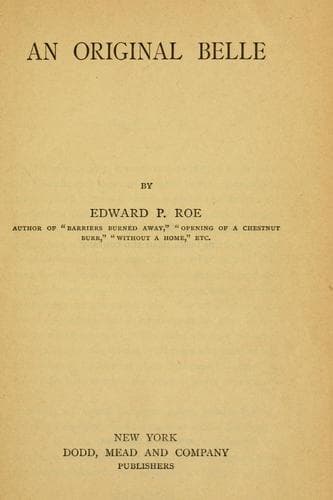
Love stories; United States -- History -- Civil War, 1861-1865 -- Fiction
This prospect grew to be so attractive that he indulged, like Mr.
Lanniere, in King Cophetua's mood, and felt that one American girl
was about to become distinguished indeed.
Watching his opportunity he called upon Mrs. Vosburgh while Marian
was out of the way, formally asking her, in her husband's absence,
for permission to pay his addresses; and he made known his financial
resources and prospects with not a little complacent detail.
Mrs. Vosburgh was dignified and gracious, enlarged on her daughter's
worth, hinted that she might be a little difficult to win by
reason of the attentions she had received and her peculiar views,
yet left, finally, the impression that so flattering proposals
could not be slighted.
Merwyn went home with a sigh of relief. He would no longer approach
Marian with doubtful and ill-defined intentions, which he believed
chiefly accounted for the clever girl's coldness towards him.
CHAPTER XIV.
OMINOUS.
SUBORDINATE only to her father and two chief friends, in Marian's
thoughts, was her enemy, for as such she now regarded Willard Merwyn.
She had felt his attentions to be humiliating from the first. They
had presented her former life, in which her own amusement and pleasure
had been her chief thought, in another and a very disagreeable
light. These facts alone would have been sufficient to awaken a
vindictive feeling, for she was no saint. In addition, she bitterly
resented his indifference to a cause made so dear by her father's
devotion and her friends' brave self-sacrifice. Whatever his
motive might be, she felt that he was cold-blooded, cowardly, or
disloyal, and such courtesy as she showed him was due to little else
than the hope of inflicting upon him some degree of humiliation.
She had seen too many manifestations of honest interest and ardent
love to credit him with any such emotion, and she had no scruples
in wounding his pride to the utmost.
Meanwhile events in the bloody drama of the war were culminating.
The Union officers were thought to have neither the wisdom to fight
at the right time nor the discretion to retreat when fighting was
worse than useless. In consequence thousands of brave men were
believed by many to have died in vain once more on the ill-fated
field of Bull Run.
One morning, the last of August, Strahan galloped to the Vosburgh
cottage and said to Marian, who met him at the door: "Orders have
come. I have but a few minutes in which to say good-by. Things
have gone wrong in Virginia, and every available man is wanted in
Washington."
His flushed face was almost as fair as her own, and gave him a boyish
aspect in spite of his military dress, but unhesitating resolution
and courage beamed from his eyes.
"Oh, that I were a man!" Marian cried, "and you would have company.
All those who are most to me will soon be perilling their lives."
"Guess who has decided to go with me almost at the last moment."
"Mr. Blauvelt?"
Public-domain text, read in full here on John Shaqi.
Reviews
Reviews
No reviews yet
Be the first to share your thoughts on this work.
Elsewhere in the archive
Join the Discussion
Join the discussion
Sign in to leave a comment or review.
Sign InorCreate an account