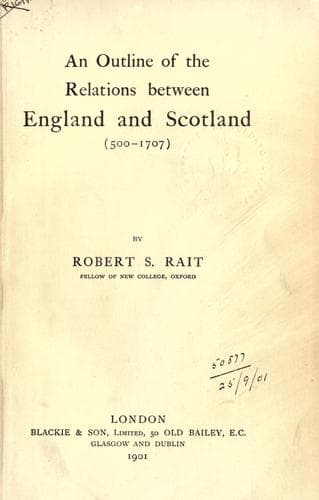
An Outline of the Relations between England and Scotland (500-1707)Rait, Robert S. (Robert Sangster)
History
An Outline of the Relations between England and Scotland (500-1707)
Rait, Robert S. (Robert Sangster)
England -- Foreign relations -- Scotland; Scotland -- Foreign relations -- England
"Mores autem Scotorum secundum diversitatem linguarum variantur;
duabus enim utuntur linguis, Scotica videlicet, et Teutonica; cujus
linguae gens maritimas possidet et planas regiones: linguae vero
gens Scoticae montanas inhabitat, et insulas ulteriores. Maritima
quoque domestica gens est, et culta, fida, patiens, et urbana;
vestitu siquidem honesta, civilis atque pacifica; circa cultum
divinum devota, sed et obviandis hostium injuriis semper prona.
Insulana vero, sive montana, ferma gens est et indomita, rudis et
immorigerata, raptu capax, otium diligens, ingenio docilis et
callida; forma spectabilis, sed amictu deformis; populo quidem
Anglorum et linguae, sed et propriae nationi, propter linguarum
diversitatem, infesta jugiter et crudelis. Regi tamen et regno
fidelis et obediens, nec non faciliter legibus subdita, si
regatur.... Scotica gens ea ab initio est quae quondam in Hibernia
fuit, et ei similis per omnia, lingua, moribus, et
natura."--_Scoti-chronicon_, Bk. ii, ch. ix.
This contrast between the Highlanders and the civilized Scots must
be read in the light of Fordun's general view of the work of the
descendants of Malcolm Canmore. He describes how David I changed
the Lowlanders into civilized men, but never hints that he did so
by introducing Englishmen. He represents the whole nation (outside
the old Northumbrian kingdom) as Picts and Scots, on whose
antiquity he lays stress, and merely mentions that Malcolm Canmore
welcomed English refugees. The following extracts show that he
looked upon the Lowlanders, not as a separate race from the
Highlanders, but simply as men of the same barbarian race who had
been civilized by David:--
"Unde tota illa gentis illius barbaries mansuefacta, tanta se mox
benevolentia et humilitate substravit, ut naturalis oblita
saevitiae, legibus quas regia mansuetudo dictabat, colla
submitteret, et pacem quam eatenus nesciebat, gratanter
acciperet."--Bk. v, ch. xxxvii.
"Ipse vero pretiosis vestibus pallia tua pilosa mutavit et antiquam
nuditatem byssa et purpura texit. Ipse barbaros mores tuos
Christiana religione composuit...."--Bk. v, ch. xliii.
(_b_) _Coronation of Alexander III as a king of Scots_
Public-domain text, read in full here on John Shaqi.
Reviews
Reviews
No reviews yet
Be the first to share your thoughts on this work.
Elsewhere in the archive
Join the Discussion
Join the discussion
Sign in to leave a comment or review.
Sign InorCreate an account