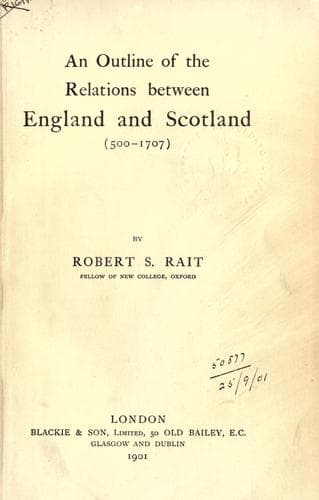
An Outline of the Relations between England and Scotland (500-1707)Rait, Robert S. (Robert Sangster)
History
An Outline of the Relations between England and Scotland (500-1707)
Rait, Robert S. (Robert Sangster)
England -- Foreign relations -- Scotland; Scotland -- Foreign relations -- England
The kingdom[94] of which Malcolm Canmore became the ruler in 1058 was
not inhabited by clans. It had been, from of old, divided into seven
provinces, each of which was inhabited by tribes. The tribe or tuath was
governed by its own chief or king (Ri or Toisech); each province or Mor
Tuath was governed by Ri Mor Tuath or Mormaer,[95] and these seven
Mormaers seem (in theory, at all events) to have elected the national
king, and to have acted as his advisers. The tribe was divided into
freemen and slaves, and freemen and slaves alike were subdivided into
various classes--noble and simple; serfs attached to land, and personal
bondmen. The land was held, not by the tribe in general, but by the
_ciniod_ or near kin of the _flath_ or senior of each family within the
tribe. On the death of a senior, the new senior was chosen (generally
with strict regard to primogeniture) from among the nearest in blood,
and all who were within three degrees of kin to him, shared in the
joint-proprietary of the proceeds of the land. The senior had special
privileges and was the representative and surety of the _ciniod_, and
the guardian of their common interests. After the third generation, a
man ceased to be reckoned among the _ciniod_, and probably received a
small personal allotment. Most of his descendants would thus be
landless, or, if they held land, would do so by what soon amounted to
servile tenure. Thus the majority of the tribe had little or nothing to
lose by the feudalization that was approaching.
The changes of Malcolm's reign are concerned with the Church, not with
land-tenure. But the territorialization of the Church, and the abolition
of the ecclesiastical system of the tribe, foreshadowed the innovations
that Malcolm's son was to introduce. We have seen that an anti-English
reaction followed the deaths of Malcolm and Margaret. This is important
because it involved an expulsion of the English from Scotland, which may
be compared with the expulsion of the Normans from England after the
return of Godwin. Our knowledge of the circumstances is derived from the
following statement of Symeon of Durham:--
"Qua [Margerita] mortua, Dufenaldum regis Malcolmi fratrem Scotti
sibi in regem elegerunt, et omnes Anglos qui de curia regis
extiterunt, de Scotia expulerunt. Quibus auditis, filius regis
Malcolmi Dunechan regem Willelmum, cui tune militavit, ut ei regnum
sui patris concederet, petiit, et impetravit, illique fidelitatem
juravit. Et sic ad Scotiam cum multitudine Anglorum et Normannorum
properavit, et patruum suum Dufenaldum de regno expulit, et in loco
ejus regnavit. Deinde nonnulli Scottorum in unum congregati,
homines illius pene omnes peremerunt. Ipse vero vix cum paucis
evasit. Veruntamen post haec illum regnare permiserunt, ea ratione,
ut amplius in Scotiam nec Anglos nec Normannos introduceret,
sibique militare permitteret."-_Rolls Series edn._, vol. ii, p.
222.
Public-domain text, read in full here on John Shaqi.
Reviews
Reviews
No reviews yet
Be the first to share your thoughts on this work.
Elsewhere in the archive
Join the Discussion
Join the discussion
Sign in to leave a comment or review.
Sign InorCreate an account