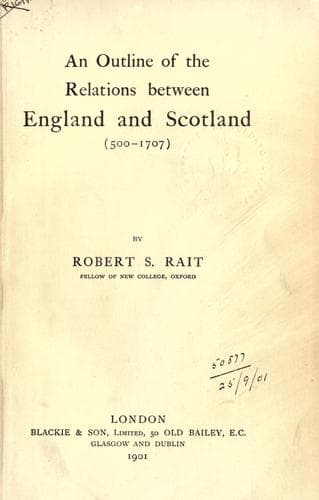
An Outline of the Relations between England and Scotland (500-1707)Rait, Robert S. (Robert Sangster)
History
An Outline of the Relations between England and Scotland (500-1707)
Rait, Robert S. (Robert Sangster)
England -- Foreign relations -- Scotland; Scotland -- Foreign relations -- England
Another century has been added to Sir Walter's _Sixty Years Since_, and
it may be argued that all the resources of modern civilisation have
failed to accomplish, in that period, what the descendants of Malcolm
Canmore effected in the twelfth and thirteenth centuries. This is true
as far as language is concerned, but only with regard to language. The
Highlanders have not forgotten the Gaelic tongue as the Lowlanders had
forgotten it by the outbreak of the War of Independence.[100] Various
facts account for this. One of the features of recent days is an
antiquarian revival, which has tended to preserve for Highland children
the great intellectual advantage of a bi-lingual education. The very
severance of the bond between chieftain and clan has helped to
perpetuate the ancient language, for the people no longer adopt the
speech of their chief, as, in earlier days, the Celt of Moray or of Fife
adopted the tongue spoken by his Anglo-Norman lord, or learned by the
great men of his own race at the court of David or of William the Lion.
The Bible has been translated into Gaelic, and Gaelic has become the
language of Highland religion. In the Lowlands of the twelfth century,
the whole influence of the Church was directed to the extermination of
the Culdee religion, associated with the Celtic language and with Celtic
civilization. Above all, the difference lies in the rise of burghs in
the Lowlands. Speech follows trade. Every small town on the east coast
was a school of English language. Should commerce ever reach the
Highlands, should the abomination of desolation overtake the waterfalls
and the valleys, and other temples of nature share the degradation of
the Falls of Foyers, we may then look for the disappearance of the
Gaelic tongue.
Be all this as it may, it is undeniable that there has been in the
Highlands, since 1745, a change of civilization without a displacement
of race. We venture to think that there is some ground for the view that
a similar change of civilization occurred in the Lowlands between 1066
and 1286, and, similarly, without a racial dispossession. We do not deny
that there was some infusion of Anglo-Saxon blood between the Forth and
the Moray Firth in the twelfth and thirteenth centuries; but there is no
evidence that it was a repopulation.
FOOTNOTES:
[Footnote 94: In this discussion the province of Lothian is not
included.]
[Footnote 95: Ri Mortuath is an Irish term. We find, more usually, in
Scotland, the Mormaer.]
[Footnote 96: _Op. cit._, vol. i, p. 254.]
[Footnote 97: _History of Scotland_, vol. i, pp. 135-6.]
[Footnote 98: _Celtic Scotland_, vol. iii, pp. 303, 309.]
[Footnote 99: _Celtic Scotland_, vol. iii, p. 368.]
[Footnote 100: It should of course be recollected that the Gaelic tongue
must have persisted in the vernacular speech of the Lowlands long after
we lose all traces of it as a literary language.]
APPENDIX C
Public-domain text, read in full here on John Shaqi.
Reviews
Reviews
No reviews yet
Be the first to share your thoughts on this work.
Elsewhere in the archive
Join the Discussion
Join the discussion
Sign in to leave a comment or review.
Sign InorCreate an account