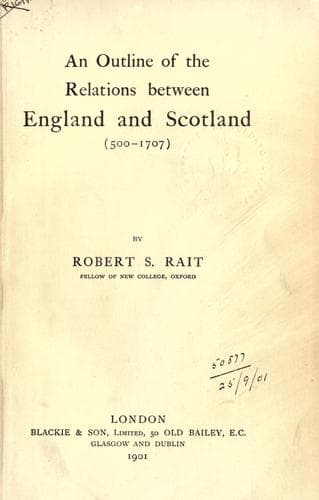
An Outline of the Relations between England and Scotland (500-1707)Rait, Robert S. (Robert Sangster)
History
An Outline of the Relations between England and Scotland (500-1707)
Rait, Robert S. (Robert Sangster)
England -- Foreign relations -- Scotland; Scotland -- Foreign relations -- England
It now remained to attack the English garrisons who held the castles of
Scotland. An invasion conducted by Edward II in 1310 proved fruitless,
and the English king returned home to enter on a long quarrel with the
Lords Ordainers, and to see his favourite, Gaveston, first exiled and
then put to death. While the attention of the rulers of England was thus
occupied, Bruce, for the first time since Wallace's inroad of 1297,
carried the war into the enemy's country, invading the north of England
both in 1311 and in 1312. Meanwhile the strongholds of the country were
passing out of the English power. Linlithgow was recovered in 1311;
Perth in January, 1312-13; and Roxburgh a month later. The romantic
capture of the castle of Edinburgh, by Randolph, Earl of Moray, in
March, 1313, is one of the classical stories of Scottish history, and
in the summer of the same year, King Robert restored the Scottish rule
in the Isle of Man. In November, 1313, only Stirling Castle remained in
English hands, and Edward Bruce rashly agreed to raise the siege on
condition that the garrison should surrender if they were not relieved
by June 24th, 1314. Edward II determined to make a heroic effort to
maintain this last vestige of English conquest, and his attempt to do so
has become irrevocably associated with the Field of Bannockburn.
In his preparations for the great struggle, which was to determine the
fate of Scotland, the Bruce carefully avoided the errors which had led
to Wallace's defeat at Falkirk. He selected a position which was
covered, on one side by the Bannock Burn and a morass, and, on the other
side, by the New Park or Forest. His front was protected by the stream
and by the famous series of "pottes", or holes, covered over so as to
deceive the English cavalry. The choice of this narrow position not only
prevented the possibility of a flank attack, but also forced the great
army of Edward II into a small space, where its numbers became a
positive disadvantage. King Robert arranged his infantry in four
divisions; in front were three schiltrons of pikemen, under Randolph,
Edward Bruce, and Sir James Douglas, and Bruce himself commanded the
reserve, which was composed of Highlanders from Argyll and the Islands
and of the men of Carrick.[49] Sir Robert Keith, the Marischal, was in
charge of a small body of cavalry, which did good service by driving
back, at a critical moment, such archers as made their way through the
forest. The English army was in ten divisions, but the limited area in
which they had to fight interfered with their arrangement. As at
Falkirk, the English cavalry made a gallant but useless charge against
the schiltrons, but it was not possible again to save the day by means
of archers, for the archers had no room to deploy, and could only make
vain efforts to shoot over the heads of the horsemen. Bruce strengthened
the Scots with his reserve, and then ensued a general action along the
whole line.
Public-domain text, read in full here on John Shaqi.
Reviews
Reviews
No reviews yet
Be the first to share your thoughts on this work.
Join the Discussion
Join the discussion
Sign in to leave a comment or review.
Sign InorCreate an account