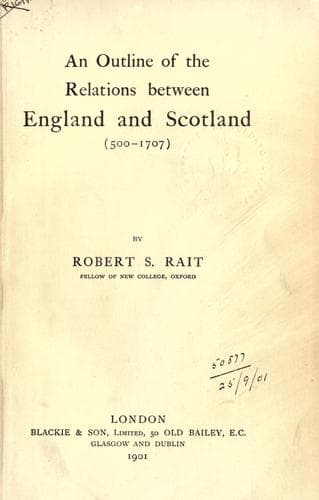
An Outline of the Relations between England and Scotland (500-1707)Rait, Robert S. (Robert Sangster)
History
An Outline of the Relations between England and Scotland (500-1707)
Rait, Robert S. (Robert Sangster)
England -- Foreign relations -- Scotland; Scotland -- Foreign relations -- England
The van of the English army was now thoroughly demoralized,
and their comrades in the rear could not, in these narrow limits, press
forward to render any assistance. King Robert's camp-followers, at this
juncture, rushed down a hill behind the Scottish army, and they appeared
to the English as a fresh force come to assist the enemy. The result was
the loss of all sense of discipline: King Edward's magnificent host fled
in complete rout and with great slaughter, and the cause of Scottish
freedom was won.
The victory of Bannockburn did not end the war, for the English refused
to acknowledge the hard-won independence of Scotland, and fighting
continued till the year 1327. The Scots not only invaded England, but
adopted the policy of fighting England in Ireland, and English reprisals
in Scotland were uniformly unsuccessful. Bruce invaded England in 1315;
in the same year, his brother Edward landed with a Scottish army at
Carrickfergus, in the hope of obtaining a throne for himself. He was
crowned King of Ireland in May, 1316, and during that and the following
year, King Robert was personally in Ireland, giving assistance to his
brother. But, in 1318, Edward Bruce was defeated and slain near Dundalk,
and, with his death, this phase of the Bruce's English policy
disappears. A few months before the death of Edward Bruce, King Robert
had captured the border town of Berwick-on-Tweed, which had been held by
the English since 1298. In 1319, Edward II sent an English army to
besiege Berwick, and the Scots replied by an invasion of England in the
course of which Douglas and Randolph defeated the English at
Mitton-on-Swale in Yorkshire. The English were led by the Archbishop of
York, and so many clerks were killed that the battle acquired the name
of the Chapter of Mitton. The war lingered on for three years more. The
year 1322 saw an invasion of England by King Robert and a
counter-invasion of Scotland by Edward II, who destroyed the Abbey of
Dryburgh on his return march. This expedition was, as usual, fruitless,
for the Scots adopted their usual tactics of leaving the country waste
and desolate, and the English army could obtain no food. In October of
the same year King Robert made a further inroad into Yorkshire, and won
a small victory at Biland Abbey. At last, in March, 1323, a truce was
made for thirteen years, but as Edward II persisted in declining to
acknowledge the independence of Scotland, it was obvious that peace
could not be long maintained.
Public-domain text, read in full here on John Shaqi.
Reviews
Reviews
No reviews yet
Be the first to share your thoughts on this work.
Join the Discussion
Join the discussion
Sign in to leave a comment or review.
Sign InorCreate an account