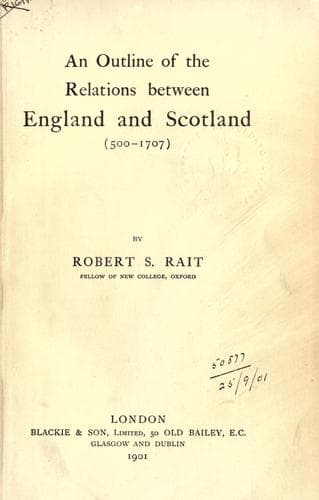
An Outline of the Relations between England and Scotland (500-1707) — John Shaqi
An Outline of the Relations between England and Scotland (500-1707)Rait, Robert S. (Robert Sangster)
History
An Outline of the Relations between England and Scotland (500-1707)
Rait, Robert S. (Robert Sangster)
England -- Foreign relations -- Scotland; Scotland -- Foreign relations -- England
With the death of Edward I the whole aspect of the contest changes. The
English were no longer conducting a great struggle for a statesmanlike
ideal, as they had been under Edward I--however impossible he himself
had made its attainment. There is no longer any sign of conscious
purpose either in their method or in their aims. The nature of the
warfare at once changed; Edward II, despite his father's wish that his
bones should be carried at the head of the army till Scotland was
subdued, contented himself with a fruitless march into Ayrshire, and
then returned to give his father a magnificent burial in Westminster
Abbey. King Robert was left to fight his Scottish enemies without their
English allies. These Scottish enemies may be divided into two
classes--the Anglo-Norman nobles who had supported the English cause
more or less consistently, and the personal enemies of the Bruce, who
increased in numbers after the murder of Comyn. Among the great families
thus alienated from the cause of Scotland were the Highlanders of Argyll
and the Isles, some of the men of Badenach, and certain Galloway clans.
But that this opposition was personal, and not racial, is shown by the
fact that, from the first, some of these Highlanders were loyal to
Bruce, _e.g._ Sir Nigel Campbell and Angus Og. We shall see, further,
that after the first jealousies caused by Comyn's death and Bruce's
success had passed away, the men of Argyll and the Isles took a more
prominent part on the Scottish side. In December, 1307, Bruce routed
John Comyn, the successor of his old rival, at Slains, on the
Aberdeenshire coast, and in the following May, when Comyn had obtained
some slight English assistance, he inflicted a final defeat upon him at
Inverurie. The power of the Comyns in their hereditary earldom of Buchan
had now been suppressed, and King Robert turned his attention to their
allies in the south. In the autumn of 1308, he himself defeated
Alexander of Lorn and subdued the district of Argyll, his brother Edward
reduced Galloway to subjection, and Douglas, along with Randolph, Earl
of Moray, was successful in Tweeddale. Thus, within three years from the
death of Comyn, Bruce had broken the power of the great families, whose
enmity against him had been aroused by that event. One year later the
other great misfortune, which had been brought upon him by the same
cause, was removed by an act which is important evidence at once of the
strength of the anti-English feeling in the country, and of the
confidence which Bruce had inspired. On the 24th February, 1309-10, the
clergy of Scotland met at Dundee and made a solemn declaration[48] of
fealty to King Robert as their lawful king. Scotland was thus united in
its struggle for independence under King Robert I.
Public-domain text, read in full here on John Shaqi.
Reviews
Reviews
No reviews yet
Be the first to share your thoughts on this work.
Join the Discussion
Join the discussion
Sign in to leave a comment or review.
Sign InorCreate an account