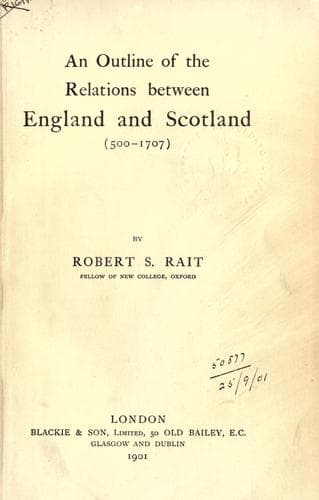
An Outline of the Relations between England and Scotland (500-1707)Rait, Robert S. (Robert Sangster)
History
An Outline of the Relations between England and Scotland (500-1707)
Rait, Robert S. (Robert Sangster)
England -- Foreign relations -- Scotland; Scotland -- Foreign relations -- England
Thus closed the portion of Scottish history which is known as the War of
Independence. The condemnation of the policy of Edward I lies simply in
its results. He found the two nations at peace and living together in
amity; he left them at war and each inspired with a bitter hatred of the
other. A policy which aimed at the unification of the island and at
preventing Scotland from proving a source of danger to England, and
which resulted in a warfare covering, almost continuously, more than two
hundred and fifty years, and which, after the lapse of four centuries,
left the policy of Scotland a serious difficulty to English ministers,
can scarcely receive credit for practical sagacity, however wise its
aim. It created for England a relentless and irritating (if not always a
dangerous) enemy, invariably ready to take advantage of English
difficulties. England had to fight Scotland in France and in Ireland,
and Edward IV and Henry VII found the King of Scots the ally of the
House of Lancaster, and the protector of Perkin Warbeck. Only the
accident of the Reformation rendered it possible to disengage Scotland
from its alliance with France, and to bring about a union with England.
Till the emergence of the religious question the English party in
Scotland consisted of traitors and mercenaries, and their efforts to
strengthen English influence form the most discreditable pages of
Scottish history.
We are not here dealing with the domestic history of Scotland; but it is
impossible to avoid a reference to the subject of the influence of the
Scottish victory upon the Scots themselves. It has been argued that
Bannockburn was, for Scotland, a national misfortune, and that Bruce's
defeat would have been for the real welfare of the country. There are,
of course, two stand-points from which we may approach the question. The
apologist of Bannockburn might lay stress on the different effects of
conquest and a hard-won independence upon the national character, and
might fairly point to various national characteristics which have been,
perhaps, of some value to civilization, and which could hardly have been
fostered in a condition of servitude. On the other hand, there arises a
question as to material prosperity. It must be remembered that we are
not here discussing the effect of a peaceful and amicable union, such as
Edward first proposed, but of a successful war of conquest; and in this
connection it is only with thankfulness and gratitude to Wallace and to
Bruce that the Scotsman can regard the parallel case of Ireland, which,
from a century before the time of Edward I, had been annexed by
conquest. The story we have just related goes to create a reasonable
probability that the fate of Scotland could not have been different;
but, further, leaving all such problems of the "might have been", we may
submit that the misery of Scotland in the fourteenth, fifteenth, and
sixteenth centuries has been much exaggerated. It is true that the
Public-domain text, read in full here on John Shaqi.
Reviews
Reviews
No reviews yet
Be the first to share your thoughts on this work.
Join the Discussion
Join the discussion
Sign in to leave a comment or review.
Sign InorCreate an account