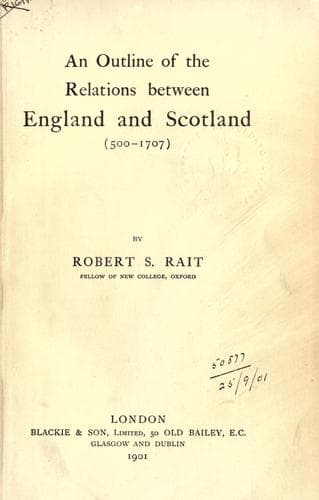
An Outline of the Relations between England and Scotland (500-1707)Rait, Robert S. (Robert Sangster)
History
An Outline of the Relations between England and Scotland (500-1707)
Rait, Robert S. (Robert Sangster)
England -- Foreign relations -- Scotland; Scotland -- Foreign relations -- England
During the fourteen years which followed his victory of Bannockburn,
King Robert was consolidating his kingdom. He had obtained recognition
even in the Western Highlands and Islands, and the sentiment of the
whole nation had gathered around him. The force of this sentiment is
apparent in connection with ecclesiastical difficulties. When Pope John
XXII attempted to make peace in 1317 and refused to acknowledge the
Bruce as king, the papal envoys were driven from the kingdom. For this
the country was placed under the papal ban, and when, in 1324, the pope
offered both to acknowledge King Robert and to remove the
excommunication, on condition that Berwick should be restored to the
English, the Scots refused to comply with his condition. A small
rebellion in 1320 had been firmly repressed by king and Parliament. The
birth of a son to King Robert, on the 5th March, 1323-24, had given
security to the dynasty, and, at the great Parliament which met at
Cambuskenneth in 1326, at which Scottish burghs were, for the first
time, represented, the clergy, the barons, and the people took an oath
of allegiance to the little Prince David, and, should his heirs fail, to
Robert, the son of Bruce's daughter, Marjorie, and her husband, Robert,
the High Steward of Scotland. The same Parliament put the financial
position of the monarch on a satisfactory footing by granting him a
tenth penny of all rents.
The deposition and murder of Edward II created a situation of which the
King of Scots could not fail to take advantage. The truce was broken in
the summer of 1327 by an expedition into England, conducted by Douglas
and Randolph, and the hardiness of the Scottish soldiery surprised the
English and warned them that it was impossible to prolong the contest in
the present condition of the two countries. The regents for the young
Edward III resolved to come to terms with Bruce. The treaty of
Northampton, dated 17th March, 1327-28, is still preserved in Edinburgh.
It acknowledged the complete independence of Scotland and the royal
dignity of King Robert. It promised the restoration of all the symbols
of Scottish independence which Edward I had removed, and it arranged a
marriage between Prince David, the heir to the Scottish throne, and
Joanna, the sister of the young king of England. A marriage ceremony
between the two children was solemnized in the following May, but the
Stone of Fate was never removed from Westminster, owing, it is said, to
the opposition of the abbot. The succession of James VI to the throne of
England, nearly three centuries later, was accepted as the fulfilment of
the prophecy attached to the Coronation Stone, "Lapis ille grandis":
"Ni fallat fatam, Scoti, quocunque locatum,
Invenient lapidem, regnare tenentur ibidem".
Public-domain text, read in full here on John Shaqi.
Reviews
Reviews
No reviews yet
Be the first to share your thoughts on this work.
Join the Discussion
Join the discussion
Sign in to leave a comment or review.
Sign InorCreate an account