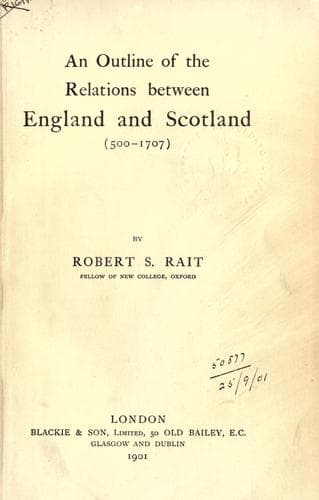
An Outline of the Relations between England and Scotland (500-1707)Rait, Robert S. (Robert Sangster)
History
An Outline of the Relations between England and Scotland (500-1707)
Rait, Robert S. (Robert Sangster)
England -- Foreign relations -- Scotland; Scotland -- Foreign relations -- England
[Footnote 47: Bruce had married, 1st, Isabella, daughter of the 10th
Earl of Mar, by whom he had a daughter, Marjorie, and 2nd, in 1302,
Elizabeth de Burgh, daughter of the Earl of Ulster.]
[Footnote 48: Nat. MSS. ii. 12, No. XVII. The original is preserved in
the Register House.]
[Footnote 49: Pinkerton suggests that King Robert adopted this
arrangement because he was unable to trust the Highlanders, but this is
unlikely, as their leader, Angus Og, had been consistently faithful to
him throughout.]
CHAPTER V
EDWARD III AND SCOTLAND
1328-1399
Almost immediately after the conclusion of the Treaty of Northampton,
the conditions of government in England and Scotland were reversed.
Since the death of Edward I, Scotland, under a strong king, had gained
by the weakness of the English sovereign; now England, under the
energetic rule of Edward III, was to profit by the death of King Robert
and by the succession of a minor. On the 7th June, 1329, King Robert
died (probably a leper) at his castle of Cardross, on the Clyde, and
left the Scottish throne to his five-year-old son, David II. In October
of the following year the young Edward III of England threw off the yoke
of the Mortimers and established his personal rule, and came almost
immediately into conflict with Scotland. The Scottish regent was
Randolph or Ranulph, Earl of Moray, the companion of Bruce and the Black
Douglas[50] in the exploits of the great war. Possibly because Edward
III had afforded protection to the Pretender, Edward Balliol, the
eldest son of John Balliol, and had received him at the English court,
Randolph refused to carry out the provisions of the Treaty of
Northampton, by which their lands were to be restored to the
"Disinherited", _i.e._ to barons whose property in Scotland had been
forfeited because they had adopted the English side in the war. A
somewhat serious situation was thus created, and Edward, not
unnaturally, took advantage of it to disown the Treaty of Northampton,
which had been negotiated by the Mortimers during his minority, and
which was extremely unpopular in England. He at once recognized Edward
Balliol as King of Scotland. The only defence of Randolph's action is
the probability that he suspected Edward to be in search of a pretext
for refusing to be bound by a treaty made in such circumstances, and if
a struggle were to ensue, it was certainly desirable not to increase the
power of the English party. Edward proceeded to assist Balliol in an
expedition to Scotland, which Mr. Lang describes as "practically an
Anglo-Norman filibustering expedition, winked at by the home government,
the filibusters being neither more nor less Scottish than most of our
_noblesse_". But before Balliol reached Scotland, the last of the
paladins whose names have been immortalized by the Bruce's wars, had
disappeared from the scene. Randolph died at Musselburgh in July, 1332,
and Scotland was left leaderless. The new regent, the Earl of Mar, was
Public-domain text, read in full here on John Shaqi.
Reviews
Reviews
No reviews yet
Be the first to share your thoughts on this work.
Join the Discussion
Join the discussion
Sign in to leave a comment or review.
Sign InorCreate an account