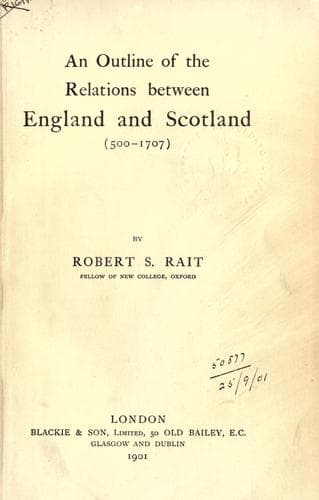
An Outline of the Relations between England and Scotland (500-1707)Rait, Robert S. (Robert Sangster)
History
An Outline of the Relations between England and Scotland (500-1707)
Rait, Robert S. (Robert Sangster)
England -- Foreign relations -- Scotland; Scotland -- Foreign relations -- England
quite incapable of dealing with the situation. When Balliol landed at
Kinghorn in August, he made his way unmolested till he reached the river
Earn, on his way to Perth. The regent had taken up a position near
Dupplin, and was at the head of a force which considerably outnumbered
the English. But the Scots had failed to learn the lesson taught by
Edward I at Falkirk and by Bruce at Bannockburn. The English succeeded
in crossing the Earn by night, and took up a position opposite the hill
on which the Scots were encamped. Their archers were so arranged as
practically to surround the Scots, who attacked in three divisions,
armed with pikes, making no attempt even to harass the thin lines of
archers who were extended on each side of the English main body. But the
unerring aim of the archers could not fail to render the Scottish attack
innocuous. The English stood their ground while line after line of the
Scots hurled themselves against them, only to be struck down by the
gray-goose shafts. At last the attack degenerated into a complete rout,
and the English made good their victory by an indiscriminate massacre.
The immediate result of the battle of Dupplin Moor was that "Edward I of
Scotland" entered upon a reign which lasted almost exactly twelve weeks.
He was crowned at Scone on September 24th, 1332, and unreservedly
acknowledged himself the vassal of the King of England. On the 16th
December the new king was at Annan, when an unexpected attack was made
upon him by a small force, led, very appropriately, by a son of
Randolph, Earl of Moray, and by the young brother of the Lord James of
Douglas. Balliol fled to Carlisle, "one leg booted and the other naked",
and there awaited the help of his liege lord, who prepared to invade
Scotland in May. Meanwhile the patriotic party had failed to take
advantage of their opportunity. Sir Andrew Moray of Bothwell, the regent
chosen to succeed Mar (who had fallen at Dupplin), had been captured in
a skirmish near Roxburgh, either in November, 1332, or in April, 1333,
and was succeeded in turn by Sir Archibald Douglas, the hero of the
Annan episode, but destined to be better known as "Tyneman the Unlucky".
The young king had been sent for safety to France.
Public-domain text, read in full here on John Shaqi.
Reviews
Reviews
No reviews yet
Be the first to share your thoughts on this work.
Elsewhere in the archive
Join the Discussion
Join the discussion
Sign in to leave a comment or review.
Sign InorCreate an account