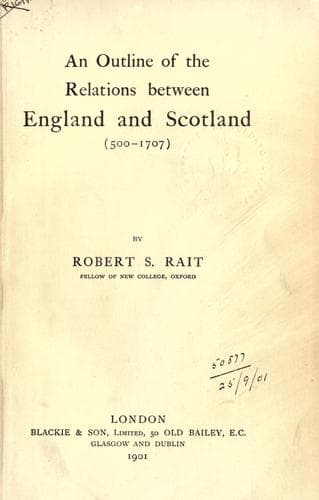
An Outline of the Relations between England and Scotland (500-1707)Rait, Robert S. (Robert Sangster)
History
An Outline of the Relations between England and Scotland (500-1707)
Rait, Robert S. (Robert Sangster)
England -- Foreign relations -- Scotland; Scotland -- Foreign relations -- England
David's residence in France and in England had entirely deprived him of
sympathy with the national aspirations of his subjects. He loved the
gay court of Edward III, and the Anglo-Norman chivalry had deeply
affected him. He hated his destined successor, and he had been charmed
by Edward's personality. Accordingly we find him, seven years after his
return to Scotland, again making a journey to England. It is a striking
fact that the son of the victor of Bannockburn should have gone to
London to propose to sell the independence of Scotland to the grandson
of Edward I. The difficulty of paying the yearly instalment of his
ransom made a limit to his own extravagant expenditure, and he now
offered, instead of money, an acknowledgment of either Edward himself or
one of his sons as the heir to the Scottish throne. The result of this
proposal was to change the policy of Edward. He abandoned the Balliol
claim and the traditional Edwardian policy in Scotland, and accepted
David's offer. David returned to Scotland and laid before his Parliament
the less violent of the two schemes, the proposal that, in the event of
his dying childless, Prince Lionel of England should succeed (1364).
"To that said all his lieges, Nay;
Na their consent wald be na way,
That ony Ynglis mannys sone
In[to] that honour suld be done,
Or succede to bere the Crown,
Off Scotland in successione,
Sine of age and off vertew there
The lauchfull airis appearand ware."
So the proposal to substitute an "English-man's son" for the lawful
heirs proved utterly futile. Equally vain were any attempts of the Scots
to mitigate Edward's rigour in the exaction of the ransom, and Edward
reverted to his earlier policy, disowned King David, and prepared for
another Scottish campaign to vindicate his right as the successor of
Balliol, who had died in 1363. But English energies were once more
diverted at a critical moment. The Black Prince had involved himself in
serious troubles in Gascony, and England was called upon to defend its
conquests in France. In 1369 a truce was made between Scotland and
England, to last for fourteen years.
Public-domain text, read in full here on John Shaqi.
Reviews
Reviews
No reviews yet
Be the first to share your thoughts on this work.
Elsewhere in the archive
Join the Discussion
Join the discussion
Sign in to leave a comment or review.
Sign InorCreate an account