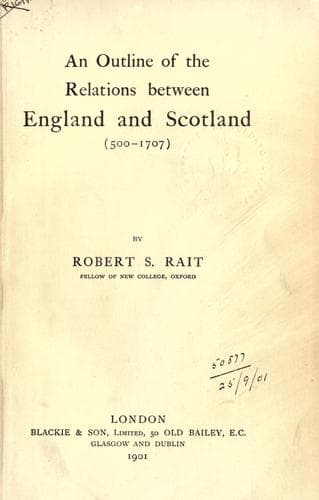
An Outline of the Relations between England and Scotland (500-1707)Rait, Robert S. (Robert Sangster)
History
An Outline of the Relations between England and Scotland (500-1707)
Rait, Robert S. (Robert Sangster)
England -- Foreign relations -- Scotland; Scotland -- Foreign relations -- England
David II died, unregretted, in February, 1370-1371. It was fortunate for
Scotland that the miserable seven years which remained to Edward III,
and the reign of his unfortunate grandson, were so full of trouble for
England. Robert the Steward succeeded his uncle without much difficulty.
He was fifty-six years of age, already an old man for those days, eight
years the senior of the nephew whom he succeeded. The main lines of the
foreign policy of his reign may be briefly indicated; but its chief
interest lies in a series of border raids, the story of which is too
intricate and of too slight importance to concern us. The new king began
by entering into an agreement with France, of a more definite
description than any previous arrangement, and the year 1372 may be
taken as marking the formal inauguration of the Franco-Scottish League.
The truce with England was continued and was renewed in 1380, three
years before the date originally fixed for its expiry. The renewal was
necessitated by various acts of hostility which had rendered it, in
effect, a dead letter. The English were still in possession of such
Scottish strongholds as Roxburgh, Berwick, and Lochmaben, and round
these there was continual warfare. The Scots sacked the town of Roxburgh
in 1377, but without regaining the castle, and, in 1378, they again
obtained possession of Berwick. John of Gaunt, who had forced the
government of his nephew to acknowledge his importance as a factor in
English politics, was entrusted with the command of an army directed
against Scotland. He met the Scottish representatives at Berwick, which
was again in English hands, and agreed to confirm the existing truce,
which was maintained till 1384, when Scotland was included in the
English truce with France. The truce, which was to last for eight
months, was negotiated in France in January, 1383-84. In February and
March, John of Gaunt conducted a ravaging expedition into Scotland as
far as Edinburgh. During the Peasants' Revolt he had taken refuge in
Scotland, and the chroniclers tell us that the expedition of 1384 was
singularly merciful. Still, it was an act of war, and the Scots may
reasonably have expressed surprise, when, in April, the French
ambassadors (who had been detained in England since February) arrived in
Edinburgh, and announced that Scotland and England had been at peace
since January. About the same time there occurred two border forays.
Some French knights, with their Scottish hosts, made an incursion into
England, and the Percies, along with the Earl of Nottingham, conducted a
devastating raid in Scotland, laying waste the Lothians. About the date
of both events there is some doubt; probably the Percy invasion was in
retaliation for the French affair. But all the time the two countries
were nominally at peace, and it was not till May, 1385, that they were
technically in a state of war. In that month a French army was sent to
Public-domain text, read in full here on John Shaqi.
Reviews
Reviews
No reviews yet
Be the first to share your thoughts on this work.
Elsewhere in the archive
Join the Discussion
Join the discussion
Sign in to leave a comment or review.
Sign InorCreate an account