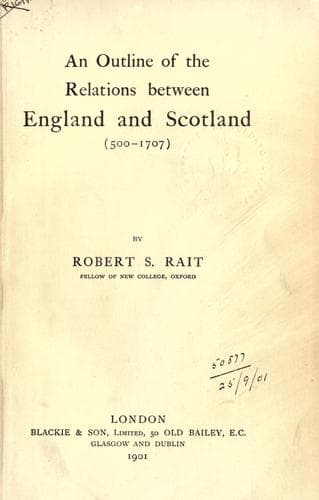
An Outline of the Relations between England and Scotland (500-1707)Rait, Robert S. (Robert Sangster)
History
An Outline of the Relations between England and Scotland (500-1707)
Rait, Robert S. (Robert Sangster)
England -- Foreign relations -- Scotland; Scotland -- Foreign relations -- England
aid the Scots, and, under the command of John de Vienne, it took part in
an incursion on a somewhat larger scale than the usual raids. The
English replied, in the month of August, by an invasion conducted by
Richard II in person, at the head of a large army, while the Scots,
declining a battle, wasted Cumberland. Richard sacked Edinburgh and
burned the great religious houses of Dryburgh, Melrose, and Newbattle,
but was forced to retire without having made any real conquest. The
Scots adopted their invariable custom of retreating after laying waste
the country, so as to deprive the English of provender; even the
impatience of their French allies failed to persuade them to give
battle to King Richard's greatly superior forces. From Scotland the
English king marched to London, to commence the great struggle which led
to the impeachment of Suffolk and the rise of the Lords Appellant. While
England was thus occupied, the Scots, under the Earl of Fife, second son
of Robert II (better known as the Duke of Albany), and the Earl of
Douglas, made great preparations for an invasion. Fife took his men into
the western counties and ravaged Cumberland and Westmoreland, but
without any important incident. Douglas attacked the country of his old
enemies, the Percies, and won the victory of Otterburn or Chevy Chase
(August, 1388), the most romantic of all the fights between Scots and
English. The Scots lost their leader, but the English were completely
defeated, and Harry Hotspur, the son of Northumberland, was made a
prisoner. Chevy Chase is the subject of many ballads and legends, and it
is indissolubly connected with the story of the House of Douglas:
"Hosts have been known at that dread sound to yield,
And, Douglas dead, his name hath won the field".
From the date of Otterburn to the accession of Henry IV there was peace
between Scotland and England, except for the never-ending border
skirmishes. Robert II died in 1390, and was succeeded by his eldest son,
John, Earl of Carrick, who took the title of Robert III, to avoid the
unlucky associations of the name of John, which had acquired an
unpleasant notoriety from John Balliol as well as John of England and
the unfortunate John of France. Under the new king the treaty with
France was confirmed, but continuous truces were made with England till
the deposition of Richard II.
FOOTNOTES:
[Footnote 50: Douglas disappeared from the scene immediately after King
Robert's death, taking the Bruce's heart with him on a pilgrimage to
Palestine. He was killed in August, 1330, while fighting the Moors in
Spain, on his way to the Holy Land.]
[Footnote 51: Minot. Tr. F. York Powell.]
CHAPTER VI
SCOTLAND, LANCASTER, AND YORK
1400-1500
Public-domain text, read in full here on John Shaqi.
Reviews
Reviews
No reviews yet
Be the first to share your thoughts on this work.
Elsewhere in the archive
Join the Discussion
Join the discussion
Sign in to leave a comment or review.
Sign InorCreate an account