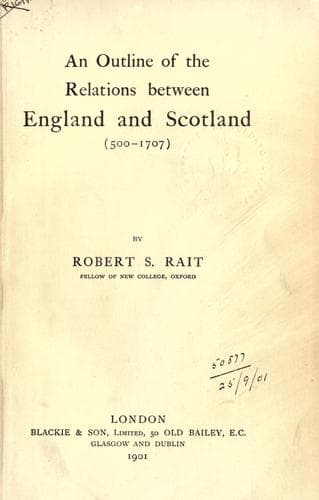
An Outline of the Relations between England and Scotland (500-1707)Rait, Robert S. (Robert Sangster)
History
An Outline of the Relations between England and Scotland (500-1707)
Rait, Robert S. (Robert Sangster)
England -- Foreign relations -- Scotland; Scotland -- Foreign relations -- England
had no intention of seriously prosecuting the claim of homage, and the
continuance of hostilities is really explained by the ill-will between
March and Douglas and the old feud between the Douglases and the
Percies. In June, 1402, the Scots were defeated in a skirmish at Nesbit
in Berwickshire (the scene of a small Scottish victory in 1355), and, in
the following September, occurred the disaster of Homildon Hill. Douglas
and Murdoch Stewart, the eldest son of Albany, had collected a large
army, and the incursion was raised to the level of something like
national importance. They marched into England and took up a strong
position on Homildon Hill or Heugh. The Percies, under Northumberland
and Hotspur, sent against them a body of English archers, who easily
outranged the Scottish bowmen, and threw the army into confusion. Then
ensued, as at Dupplin and Halidon Hill, a simple massacre. Murdoch
Stewart and Douglas were taken captive with several other Scots lords.
Close on Homildon Hill followed the rebellion of the Percies, and the
result of the English victory at Homildon was merely to create a new
difficulty for Henry IV. The sudden nature of the Percy revolt is
indicated by the fact that, when Albany marched to relieve a Scottish
stronghold which they were besieging, he found that the enemy had
entered into an alliance with the House of Douglas, their ancient foes,
and were turning their arms against the English king. Percy and Douglas
fought together at Shrewsbury, while the Earl of March was in the ranks
of King Henry.
The battle of Shrewsbury was fought in July, 1403. In 1405,
Northumberland, a traitor for a second time, took refuge in Scotland,
and received a dubious protection from Albany, who was ready to sell him
should any opportunity arise. A truce which had been arranged between
Scotland and England expired in April, 1405, and the two countries were
technically in a state of war, although there were no great military
operations in progress.[53] In the spring of 1406, Albany sent the heir
to the Scottish throne, Prince James, to be educated in France. The
vessel in which he sailed was captured by the English off Flamborough
Head, and the prince was taken to Henry IV. It has been a tradition in
Scotland that James was captured in time of truce, and Wyntoun uses the
incident to point a moral with regard to the natural deceitfulness of
the English heart:
"It is of English nationn
The common kent conditionn
Of Truth the virtue to forget,
When they do them on winning set,
And of good faith reckless to be
When they do their advantage see."
Public-domain text, read in full here on John Shaqi.
Reviews
Reviews
No reviews yet
Be the first to share your thoughts on this work.
Elsewhere in the archive
Join the Discussion
Join the discussion
Sign in to leave a comment or review.
Sign InorCreate an account