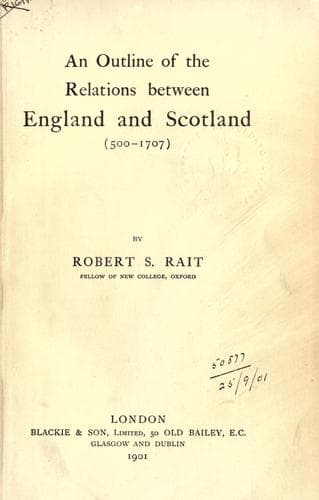
An Outline of the Relations between England and Scotland (500-1707)Rait, Robert S. (Robert Sangster)
History
An Outline of the Relations between England and Scotland (500-1707)
Rait, Robert S. (Robert Sangster)
England -- Foreign relations -- Scotland; Scotland -- Foreign relations -- England
But it would seem clear that the truce had expired, and that the English
king was bound to no treaty of peace. His son's capture was immediately
followed by the death of King Robert III, who sank, broken-hearted, into
the grave. Albany continued to rule, and maintained a series of truces
with England till his death in 1420. The peace was occasionally broken
in intervals of truce, and the advantage was usually on the side of the
Scots. In 1409 the Earl of March returned to his allegiance and received
back his estates. In the same year his son recovered Fast Castle (on St.
Abb's Head), and the Scots also recovered Jedburgh.
Albany's attention was now diverted by a danger threatened by the
Highland portion of the kingdom. Scotland, south of Forth and Clyde,
along with the east coast up to the Moray Firth, had been rapidly
affected by the English, French, and Norman influences, of which we
have spoken. The inhabitants of the more remote Highland districts and
of the western isles had remained uncorrupted by civilization of any
kind, and ever since the reign of Malcolm Canmore there had been a
militant reaction against the changes of St. Margaret and David I; from
the eleventh century to the thirteenth, the Scottish kings were scarcely
ever free from Celtic pretenders and Celtic revolts.[54] The inhabitants
of the west coast and of the isles were very largely of Scandinavian
blood, and it was not till 1266 that the western isles definitely passed
from Norway to the Scottish crown. The English had employed several
opportunities of allying themselves with these discontented Scotsmen;
but Mr. Freeman's general statement, already quoted, that "the true
Scots, out of hatred to the Saxons nearest them, leagued with the Saxons
farther off", is very far from a fair representation of the facts. We
have seen that Highlander and Islesman fought under David I at the
battle of the Standard, against the "Saxons farther off", and that
although the death of Comyn ranged against Bruce the Highlanders of
Argyll, numbers of Highlanders were led to victory at Bannockburn by
Earl Randolph; and Angus Og and the Islesmen formed part of the Scottish
reserves and stood side by side with the men of Carrick, under the
leadership of King Robert. During the troubles which followed King
Robert's death, the Lords of the Isles had resumed their general
attitude of opposition. It was an opposition very natural in the
circumstances, the rebellion of a powerful vassal against a weak central
government, a reaction against the forces of civilization. But it has
never been shown that it was an opposition in any way racial; the
complaint that the Lowlands of Scotland have been "rent by the Saxon
from the Gael", in the manner of a racial dispossession, belongs to "The
Lady of the Lake", not to sober history. All Scotland, indeed, has now,
in one sense, been "rent by the Saxon" from the Celt. "Let no one doubt
the civilization of these islands," wrote Dr. Johnson, in Skye, "for
Public-domain text, read in full here on John Shaqi.
Reviews
Reviews
No reviews yet
Be the first to share your thoughts on this work.
Elsewhere in the archive
Join the Discussion
Join the discussion
Sign in to leave a comment or review.
Sign InorCreate an account