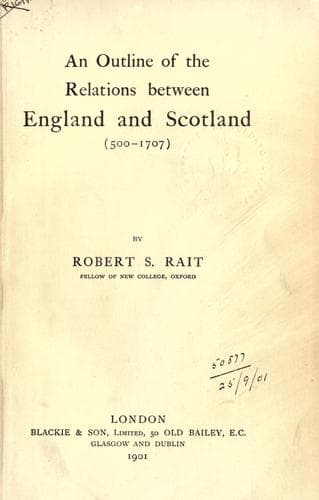
An Outline of the Relations between England and Scotland (500-1707)Rait, Robert S. (Robert Sangster)
History
An Outline of the Relations between England and Scotland (500-1707)
Rait, Robert S. (Robert Sangster)
England -- Foreign relations -- Scotland; Scotland -- Foreign relations -- England
Portree possesses a jail." The Highlands and islands have been the last
portions of Scotland to succumb to Anglo-Saxon influences; that the
Lowlands formed an earlier victim does not prove that their racial
complexion is different. The incident of which we have now to speak has
frequently been quoted as a crowning proof of the difference between the
Lowlanders and the "true Scots". Donald of the Isles had a quarrel with
the Regent Albany, and, in 1408, entered into an agreement with Henry
IV, to whom he owned allegiance. But this very quarrel arose about the
earldom of Ross, which was claimed by Donald (himself a grandson of
Robert II) in right of his wife, a member of the Leslie family. The
"assertor of Celtic nationality" was thus the son of one Lowland woman
and the husband of another. When he entered the Scottish mainland his
progress was first opposed, not by the Lowlanders, but by the Mackays of
Caithness, who were defeated near Dingwall, and the Frasers immediately
afterwards received what the historians of the Clan Donald term a
"well-merited chastisement".[55] Donald pursued his victorious march to
Aberdeenshire, tempted by the prospect of plundering Aberdeen. It is
interesting to note that, while the battle which has given significance
to the record of the dispute was fought for the Lowland town of Aberdeen
in a Lowland part of Aberdeenshire, the very name of the town is Celtic,
and the district in which the battlefield of Harlaw is situated abounds
to this day in Celtic place-names, and, not many miles away, the Gaelic
tongue may still be heard at Braemar or at Tomintoul. It was not to a
racial battle between Celt and Saxon that the Earl of Mar and the
Provost of Aberdeen, aided by the Frasers, marched out to Harlaw, in
July, 1411, to meet Donald of the Isles. Had the clansmen been
victorious there would certainly have been a Celtic revival; but this
was not the danger most dreaded by the victorious Lowlanders. The battle
of Harlaw was part of the struggle with England. Donald of the Isles was
the enemy of Scottish independence, and his success would mean English
supremacy. He had taken up the role of "the Disinherited" of the
preceding century, just as the Earl of March had done some years before.
As time passed, and civilization progressed in the Lowlands while the
Highlands maintained their integrity, the feeling of separation grew
more strongly marked; and as the inhabitants of the Lowlands
intermarried with French and English, the differences of blood became
more evident and hostility became unavoidable. But any such abrupt
racial division as Mr. Freeman drew between the true Scots and the
Scottish Lowlanders stands much in need of proof.
Public-domain text, read in full here on John Shaqi.
Reviews
Reviews
No reviews yet
Be the first to share your thoughts on this work.
Elsewhere in the archive
Join the Discussion
Join the discussion
Sign in to leave a comment or review.
Sign InorCreate an account