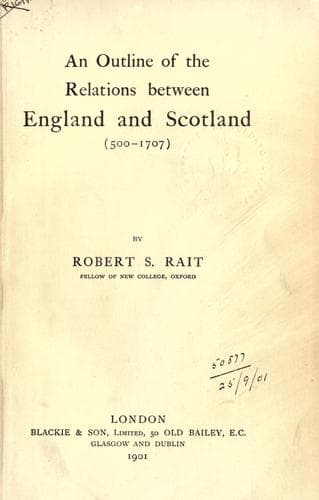
An Outline of the Relations between England and Scotland (500-1707)Rait, Robert S. (Robert Sangster)
History
An Outline of the Relations between England and Scotland (500-1707)
Rait, Robert S. (Robert Sangster)
England -- Foreign relations -- Scotland; Scotland -- Foreign relations -- England
Henry VIII succeeded to the throne of England in April, 1509; three
years and five months later, in September, 1513, was fought the battle
of Flodden. The causes may soon be told. They fall under three heads.
James and Henry were alike headstrong and impetuous, and they were alike
ambitious of playing a considerable part in European affairs. They were,
moreover, brothers-in-law, and, in the division of the inheritance of
Henry VII, the King of England had, with characteristic Tudor avarice,
retained jewels and other property which had been left to his sister,
the Queen of Scots. In the second place, the ancient jealousies were
again roused by disputes on the borders, and by naval warfare. James had
long been engaged in "the building of a fleet for the protection of our
shores"; in 1511, he had built the _Great Michael_, for which, it was
said, the woods of Fife had been wasted. The Scottish fleet was
frequently involved in quarrels with Henry's ships, and in August, 1511,
the English took two Scottish vessels, which they alleged to be pirates,
and Andrew Barton was slain in the fighting. James demanded redress,
but, says Hall, "the King of England wrote with brotherly salutations
to the King of Scots of the robberies and evil doings of Andrew Barton;
and that it became not one prince to lay a breach of a league to another
prince, in doing justice upon a pirate or thief".[60] These personal
irritations and petty troubles might have proved harmless, and, had no
European complications intervened, it is possible that there might have
"from Fate's dark book a leaf been torn", the leaf which tells of
Flodden Field. But, in 1511, Julius II formed the Holy League against
France, and by the end of the year it included Spain, Austria, and
England. The formation of a united Europe against the ancient ally of
Scotland thoroughly alarmed James. It was true that, at the moment,
England was willing to be friendly; but, should France be subdued,
whither might Scotland look for help in the future? James used every
effort to prevent the League from carrying out their project; he
attempted to form a coalition of Denmark, France, and Scotland, and
wrote to his uncle, the King of Denmark, urging him to declare for the
Most Christian King. He wrote Henry offering to "pardon all the damage
done to us and our kingdom, the capture of our merchant ships, the
slaughter and imprisonment of our subjects", if only Henry would
"maintain the universal concord of the Church". He made a vigorous
appeal to the pope himself, beseeching him to keep the peace. His
efforts were, of course, futile, nor was France in such extreme danger
as he supposed. But the chance of proving himself the saviour of France
appealed strongly to him, and, when there came to him, in the spring of
1513, a message from the Queen of France, couched in the bygone language
of chivalry, and urging him, as her knight, to break a lance for her on
English soil, James could no longer hesitate.
Public-domain text, read in full here on John Shaqi.
Reviews
Reviews
No reviews yet
Be the first to share your thoughts on this work.
Elsewhere in the archive
Join the Discussion
Join the discussion
Sign in to leave a comment or review.
Sign InorCreate an account