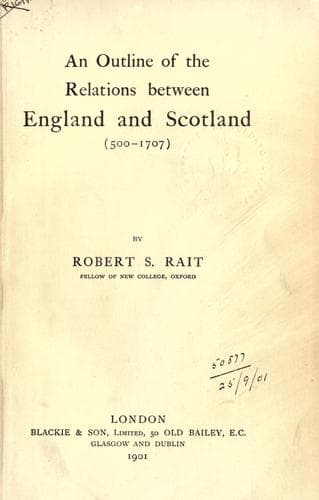
An Outline of the Relations between England and Scotland (500-1707)Rait, Robert S. (Robert Sangster)
History
An Outline of the Relations between England and Scotland (500-1707)
Rait, Robert S. (Robert Sangster)
England -- Foreign relations -- Scotland; Scotland -- Foreign relations -- England
1537, and the relations between James and Henry VIII (now a widower by
the death of Jane Seymour) were further strained by the fact that nephew
and uncle alike desired the hand of Mary of Guise, widow of the Duke de
Longueville, who preferred her younger suitor and married him in the
following summer. These two French marriages are important as marking
James's final rejection of the path marked out for him by Henry VIII.
The husband of a Guise could scarcely remain on good terms with the
heretic King of England; but Henry, with true Tudor persistency, did not
give up hope of bending his nephew to his will, and spent the next few
years in negotiating with James, in trying to alienate him from Cardinal
Beaton--the great supporter of the French alliance,--and in urging the
King of Scots to enrich himself at the expense of the Church. As late as
1541, a meeting was arranged at York, whither Henry went, to find that
his nephew did not appear. James was probably wise, for we know that
Henry would not have scrupled to seize his person. Border troubles
arose; Henry reasserted the old claim of homage and devised a scheme to
kidnap James. Finally he sent the Earl of Angus, who had been living in
England, with a force to invade Scotland, and this without the formality
of declaring war. Henry, in fact, was acting as a suzerain punishing a
vassal who had refused to appear when he was summoned. The English
ravaged the county of Roxburgh in 1542; the Scottish nobles declined to
cross the border in what they asserted to be a French quarrel; and in
November a small Scottish force was enclosed between Solway Moss and the
river Esk, and completely routed. The ignominy of this fresh disaster
broke the king's heart. On December 8th was born the hapless princess
who is known as _the_ Queen of Scots. The news brought small comfort to
the dying king, who was still mourning the sons he had lost in the
preceding year. "'Adieu,' he said, 'farewell; it came with a lass and it
will pass with a lass.' And so", adds Pitscottie, "he recommended
himself to the mercy of Almighty God, and spake little from that time
forth, but turned his back unto his lords, and his face unto the wall."
Six days later the end came. With "a little smile of laughter", and
kissing his hand to the nobles who stood round, he breathed his last.
FOOTNOTES:
[Footnote 60: Gregory Smith, p. 123.]
CHAPTER VIII
THE PARTING OF THE WAYS
1542-1568
Public-domain text, read in full here on John Shaqi.
Reviews
Reviews
No reviews yet
Be the first to share your thoughts on this work.
Elsewhere in the archive
Join the Discussion
Join the discussion
Sign in to leave a comment or review.
Sign InorCreate an account