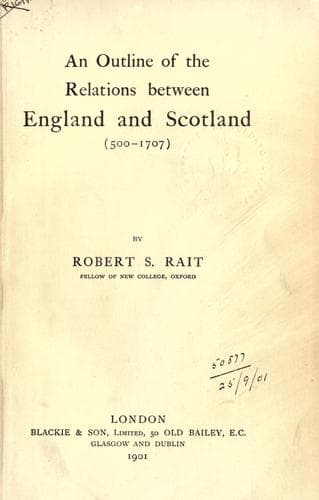
An Outline of the Relations between England and Scotland (500-1707)Rait, Robert S. (Robert Sangster)
History
An Outline of the Relations between England and Scotland (500-1707)
Rait, Robert S. (Robert Sangster)
England -- Foreign relations -- Scotland; Scotland -- Foreign relations -- England
The queen "embracit him and kisset
him, alleging that in caice he had bene at hame, he wald not have
sufferit her to have bene sa uncourterly handlit". But the success ended
here. Mary won over her husband, and together they escaped and fled to
Dunbar. Darnley deserted his accomplices, proclaimed his innocence, and
strongly urged the punishment of the murderers. They, of course, threw
themselves on the hospitality of Queen Elizabeth, who sent them money,
and lied to Mary,[75] who did not put too much faith in her cousin's
assurances. On June 19th, a prince was born in Edinburgh Castle, but the
event brought about only a partial reconciliation between his unhappy
parents. Mary was shamefully treated by her worthless husband, and in
the following November her nobles suggested to her the project of a
divorce. Darnley, however, was not doomed to the fate which overtook his
descendants, the life of a king without a crown. He had awakened the
enmity of men whose feuds were blood-feuds, and the Rizzio conspirators
were not likely to forgive the upstart youth whose inconstancy had
foiled their plan for Mary's fall, and whose treachery had involved them
in exile. Darnley had proved useless even as a tool for the nobles, he
had offended Mary and disgusted everybody in Scotland, and there were
many who were willing to do without him. At this point a new tool was
ready to the hands of the discontented barons. The Earl of Bothwell,
whether with Mary's consent or not, aspired to the queen's hand, and
devised a plan for the murder of Darnley. On the night of the 10th
February, 1566-67, the wretched boy, not yet twenty-one years of age,
was strangled,[76] and the house in which he had been living was blown
up with gunpowder. Public opinion accused Bothwell of the murder; he was
tried and found innocent, and Parliament put its seal upon his
acquittal. On the 24th April he seized the person of the queen as she
was travelling from Linlithgow to Edinburgh, and Mary married him on the
15th May. _Mense malum Maio nubere vulgus ait._ The nobles almost
immediately raised a rebellion, professedly to deliver the queen from
the thraldom of Bothwell. On June 15th she surrendered at Carberry Hill,
and the nobles disregarded a pledge of loyalty to the queen given on
condition of her abandoning Bothwell, alleging that she was still in
correspondence with him. They now accused her of murdering her husband,
and imprisoned her in Lochleven Castle. The whole affair is wrapped in
mystery, but it is impossible to give the Earl of Morton and the other
nobles any credit for honesty of purpose. There can be little doubt that
they used Bothwell for their own ends, and, while they represented the
murder as the result of a domestic conspiracy between the queen and
Bothwell, they afterwards, when quarrelling among themselves, hurled at
each other accusations of participation in the plot, and their leader,
the Earl of Morton, died on the scaffold as a criminal put to death for
Public-domain text, read in full here on John Shaqi.
Reviews
Reviews
No reviews yet
Be the first to share your thoughts on this work.
Elsewhere in the archive
Join the Discussion
Join the discussion
Sign in to leave a comment or review.
Sign InorCreate an account