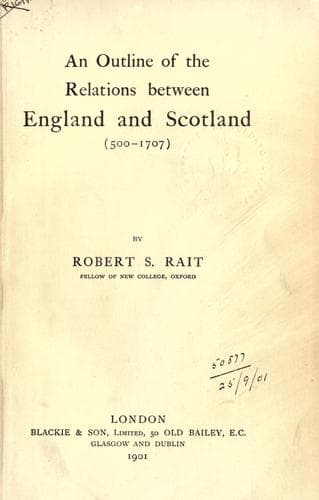
An Outline of the Relations between England and Scotland (500-1707)Rait, Robert S. (Robert Sangster)
History
An Outline of the Relations between England and Scotland (500-1707)
Rait, Robert S. (Robert Sangster)
England -- Foreign relations -- Scotland; Scotland -- Foreign relations -- England
the Earl of Moray returned to Scotland, with an increased allowance of
English gold. Henceforth the successive regents of Scotland had to guide
their policy in accordance with Elizabeth's wishes. If they rebelled,
she could always threaten to release her prisoner, and, once or twice in
the course of those long, weary years, Mary, whose nature was buoyant,
actually dared to hope that Elizabeth would replace her on her throne.
While Mary was plotting, and hope deferred was being succeeded by hope
deferred and vain illusion by vain illusion, events moved fast. In
November, 1569, the Earls of Northumberland and Westmoreland raised a
rebellion in her favour, which was easily suppressed. In January, 1570,
Moray was assassinated at Linlithgow, and the Earl of Lennox, the father
of Darnley, and the traitor of Mary's minority, succeeded to the
regency, while Mary's Scottish supporters, who had continued to fight
for her desperate cause, were strengthened by the accession of Maitland
of Lethington, who, with Kirkaldy of Grange, also a recruit from the
king's party, held Edinburgh Castle for the queen. Mary's hopes were
further raised by the rebellion of the Duke of Norfolk, whose marriage
with the Scottish queen had been suggested in 1569. Letters from the
papal agent, Rudolfi, were discovered, and, in June, 1572, Norfolk was
put to death. Lennox had been killed in September, 1571, and his
successor, the Earl of Mar, was approached on the subject of taking
Mary's life. Elizabeth was unwilling to accept the responsibility for
the deed, and proposed to deliver up Mary to Mar, on the understanding
that she should be immediately killed. Mar, who was an honourable man,
declined to listen to the proposal. But, after his death, which occurred
in October, 1572, the new regent, the Earl of Morton, professed his
willingness to undertake the accomplishment of the deed, if Elizabeth
would openly acknowledge it. This she refused to do, and the plot
failed. It is characteristic that the last Douglas to play an important
part in Scottish history should be the leading actor in such a plot as
this.
Public-domain text, read in full here on John Shaqi.
Reviews
Reviews
No reviews yet
Be the first to share your thoughts on this work.
Elsewhere in the archive
Join the Discussion
Join the discussion
Sign in to leave a comment or review.
Sign InorCreate an account