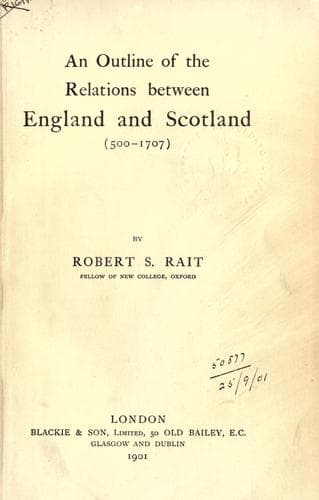
An Outline of the Relations between England and Scotland (500-1707)Rait, Robert S. (Robert Sangster)
History
An Outline of the Relations between England and Scotland (500-1707)
Rait, Robert S. (Robert Sangster)
England -- Foreign relations -- Scotland; Scotland -- Foreign relations -- England
"agreeth as well with a king as God with the Devil." So he went to
England, not only prepared to welcome the episcopal form of
church-government and to graciously receive the episcopal adulation so
freely showered upon him, but also determined to suppress, at all
hazards, "the proud Puritanes, who, claining to their Paritie, and
crying, 'We are all but vile wormes', yet will judge and give Law to
their king, but will be judged nor controlled by none".[85] "God's
sillie vassal" was Melville's summing-up of the royal character in
James's own presence. "God hath given us a Solomon", exulted the Bishop
of Winchester, and he recorded the fact in print, that all the world
might know. James was wrong in mistaking the English Puritans for the
Scottish Presbyterians. Alike in number, in influence, and in aim, his
new subjects differed from his old enemies. English Puritanism had
already proved unsuited to the genius of the nation, and it had given up
all hope of the abolition of Episcopacy. The Millenary Petition asked
only some changes in the ritual of the Church and certain moderate
reforms. Had James received their requests in a more reasonable spirit,
he might have succeeded in reconciling, at all events, the more moderate
section of them to the Church, and at the very first it seemed as if he
were likely to win for himself the blessing of the peace-maker, which
he was so eager to obtain. But just at this crisis he found the first
symptoms of Parliamentary opposition, and here again his training in
Scotland interfered. The Church and the Church alone had opposed him in
Scotland; he had never discovered that a Parliament could be other than
subservient.[86] It was, therefore, natural for him to connect the
Parliamentary discontent with Puritan dissatisfaction. Scottish Puritans
had employed the General Assembly as their main weapon of offence; their
English fellows evidently desired to use the House of Commons as an
engine for similar purposes. Therefore said King James, "I shall make
them conform themselves, or I will harry them out of the land, or else
do worse". So he "did worse", and prepared the way for the Puritan
revolution. If the English succession enabled the king to suppress the
Scottish Assembly, the Assembly had its revenge, for the fear of it
brought a snare, and James may justly be considered one of the founders
of English dissent.
Public-domain text, read in full here on John Shaqi.
Reviews
Reviews
No reviews yet
Be the first to share your thoughts on this work.
Elsewhere in the archive
Join the Discussion
Join the discussion
Sign in to leave a comment or review.
Sign InorCreate an account