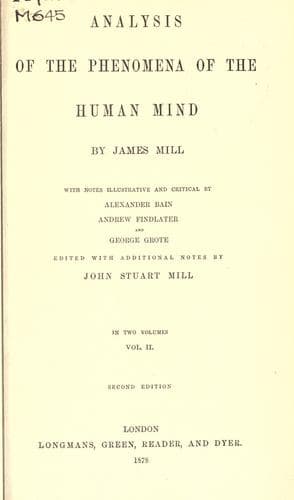
Analysis of the Phenomena of the Human MindMill, James
PhilosophyPhilosophy
Analysis of the Phenomena of the Human Mind
Mill, James
Psychology
By the power, however, which we have over the occasions of our
sensations, we can make sure of having a train of sensations exactly
the same as we have had before. This affords us the means of having
a train of ideas exactly the same as we have had before. If we
choose a number of sensible objects, and make use of them as marks
of our ideas, we can ensure any succession which we please of the
sensible objects; and, by the association between them and the
ideas, a corresponding succession of the ideas.
6. To one of the two sets of occasions, upon which Signs are thus
useful, _evanescent_ Signs are the best adapted; _permanent_ signs
are absolutely necessary for the other. For the purposes of speech,
or immediate communication, sounds are the most convenient marks.
Sounds, however, perish in the making. But for the purpose of
retracing a train of ideas, which we have formerly had, it is
necessary we should have marks which do not perish. Marks, addressed
to the sight, or the touch, have the requisite permanence; and, of
the two, those addressed to the eye have the advantage. Of marks
addressed to the eye, two kinds have been adopted; either marks
immediately of the ideas intended to be recalled; such as the
picture-writing, or hieroglyphics, of some nations: or, visible
marks, by letters, of the audible marks employed in oral
communication. This latter kind has been found the most convenient,
and in use among the largest, and most intelligent portion of our
species.
{133} According to this scheme, spoken language is the use of
immediate marks of the ideas; written language, is the use of
secondary marks of the ideas. The written marks are only signs of
the audible marks; the audible marks, are signs of the ideas.[40]
[Editor's footnote 40: This exposition of Naming in its most general
aspect, needs neither explanation nor comment. It is one of those
specimens of clear and vigorous statement, going straight to the
heart of the matter, and dwelling on it just long enough and no
longer than necessary, in which the Analysis abounds.--_Ed._]
{134} SECTION I.
NOUNS SUBSTANTIVE.
The power of Language essentially consists, in two things; first, in
our having marks of our SENSATIONS, and IDEAS: and, secondly, in so
arranging them, that they may correctly denote a TRAIN of those
mental states or feelings. It is evident, that if we convey to
others the ideas which pass in our own minds, and also convey them
in the order in which they pass, the business of COMMUNICATION is
completed. And, if we establish the means of reviving the ideas
which we have formerly had, and also of reviving them in the order
in which we formerly had them, the business of RECORDATION is
completed. We now proceed to show, by what contrivances, the
expedient of Marking is rendered efficient to those several ends.
Public-domain text, read in full here on John Shaqi.
Reviews
Reviews
No reviews yet
Be the first to share your thoughts on this work.
Elsewhere in the archive
Join the Discussion
Join the discussion
Sign in to leave a comment or review.
Sign InorCreate an account