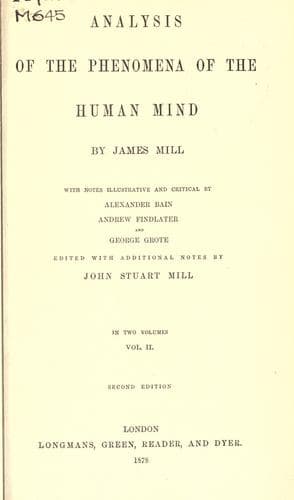
Analysis of the Phenomena of the Human MindMill, James
PhilosophyPhilosophy
Analysis of the Phenomena of the Human Mind
Mill, James
Psychology
Neither is it strictly accurate to say that Verbs are always marks
of motion, or of action, even including, as the author does, by an
extension of the meaning of those terms, every process which is
attended with a feeling of effort. Many verbs, of the kind which
grammarians call neuter or intransitive verbs, express rest, or
inaction: as sit, lie, and in some cases, stand. It is true however
that the verbs first invented, as far as we know anything of them,
expressed forms of motion, and the principal function of verbs still
is to affirm or deny action. Or, to speak yet more generally, it is
by means of verbs that we predicate events. Events, or changes, are
the most important facts, to us, in the surrounding world. Verbs are
the resource which language affords for predicating events. They are
not the names of events; all names of events are substantives, as
sunrise, disaster, or *infinitives, as _to rise_, and infinitives
are logically substantives. But it is by means of verbs that we
assert, or give information of, events; as, The sun rises, or,
Disaster has occurred. There is, however, a class of neuter verbs
already referred to, which do not predicate events, but states
of an unchanging object, as lie, sit, remain, exist. It would be
incorrect, therefore, to give a definition of Verbs which should
limit them to the expression of events. I am inclined to think that
the distinction between nouns and verbs is not logical, but merely
grammatical, and that every word, whatever be its meaning, must be
reputed a verb, which is so constructed grammatically that it can
only be used as the predicate of a proposition. Any meaning whatever
is, in strictness, capable of being thrown into this form: but it is
only certain meanings, chiefly actions or events, which there is, in
general, any motive for putting into this particular shape.--_Ed._]
{156} 6. We have, last of all, under this head, to consider the
marking power of a very peculiar, and most comprehensive word, the
SUBSTANTIVE VERB, as it has been called by grammarians, or the word
expressive of BEING. The steps, which we have already traced, in the
process of naming, will aid us in obtaining a true conception of
this, which is one of the most important steps, in that process.
Public-domain text, read in full here on John Shaqi.
Reviews
Reviews
No reviews yet
Be the first to share your thoughts on this work.
Elsewhere in the archive
Join the Discussion
Join the discussion
Sign in to leave a comment or review.
Sign InorCreate an account