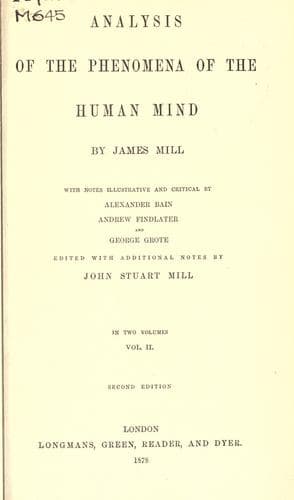
Analysis of the Phenomena of the Human MindMill, James
PhilosophyPhilosophy
Analysis of the Phenomena of the Human Mind
Mill, James
Psychology
The account which the author gives of a Predication, or Proposition,
is, first, that it is a mode of so putting together the marks of
sensations and ideas, as to mark the order of them. Secondly, that
it consists in substituting one name for another, so as to signify
that a certain name (called the predicate), is a mark of the same
idea which another name (called the subject) is a mark of.
It must be allowed that a predication, or proposition, is intended
to mark some portion of the order either of our sensations or of our
ideas, _i.e._, some part of the coexistences or sequences which take
place either in our minds, or in what we term the external world.
But what sort of order is it that a predication marks? An order
supposed to be believed in. When _John_, or _man_, are said to be
marks of an individual object, all there is in the matter is that
these words, being associated with the idea of the object, are
intended to raise that idea in the mind of the person who hears or
reads them. But when we say, John is a man, or, John is an old man,
we intend to do more than call up in the hearer's mind the images of
John, of a man, and of an old man. We intend to do more than inform
him that we have thought of, or even seen, John and a man, or John
and an old man, together. We inform him of a fact respecting John,
namely, that he _is_ an old man, or at all events, of our belief
that this is a fact. The characteristic difference between a
predication and any other form of speech, is, that it does not
merely bring to mind a certain object (which is the only function of
a mark, merely as such); it asserts something respecting it. Now it
may be true, and I think it is true, that every assertion, every
object of Belief,--everything that can be true or false--that can be
an object of assent or dissent--is some order of sensations or of
ideas: some coexistence or succession of sensations or ideas
actually experienced, or supposed capable of being experienced. And
thus it may appear in the end that in expressing a belief, we are
after all only declaring the order of a group or series of
sensations or ideas. But the order which we declare is not an
imaginary order; it is an order believed to be real. Whatever view
we adopt of the psychological nature of Belief, it is necessary to
distinguish between the mere suggestion, to the mind of a certain
order among sensations or ideas such as takes place when we think of
the alphabet, or the numeration table and the indication that this
order is an actual fact, which is occurring, or which has occurred
once or oftener, or which, in certain definite circumstances, always
occurs; which are the things indicated as true by an affirmative
predication, and as false by a negative one.
Public-domain text, read in full here on John Shaqi.
Reviews
Reviews
No reviews yet
Be the first to share your thoughts on this work.
Elsewhere in the archive
Join the Discussion
Join the discussion
Sign in to leave a comment or review.
Sign InorCreate an account