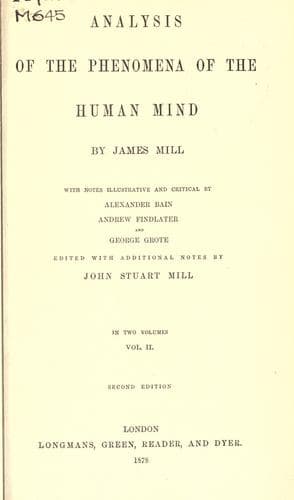
Analysis of the Phenomena of the Human MindMill, James
PhilosophyPhilosophy
Analysis of the Phenomena of the Human Mind
Mill, James
Psychology
2. The trains of thought which pass in our minds, are sequences, the
items of which are connected in three principal ways: 1st, as cause
and effect; 2dly, as resembling; 3dly, as included under the same
name. A short illustration of each of these cases will {187}
complete the account of predication, as a contrivance for marking
the order of ideas.
To illustrate a sequence, connected as Cause and Effect, let me
suppose that I have a flint and steel in my hand, which I am about
to strike, one against the other, but at that instant perceive a
barrel of gunpowder open, close before me. I withhold the stroke in
consequence of the train of thought which suggests to me the
ultimate effect. If I have occasion to mark the train, I can only do
it by a series of Predications, each of which marks a sequence in
the train of causes and effects. "I strike the flint on the steel,"
first sequence. "The stroke produces a spark," second sequence. "The
spark falls on gunpowder," third sequence. "The spark ignites the
gunpowder," fourth sequence. "The gunpowder ignited makes an
explosion," fifth sequence. The ideas contained in these
propositions must all have passed through my mind, and this is the
only mode in which language enables me to mark them in their
order.[55]
[Editor's footnote 55: It is necessary again to notice the
consistent omission, throughout the author's theory of Predication,
of the element Belief. In the case supposed, the ideas contained in
all the propositions might have passed through the mind, without our
being led to assert the propositions. I might have thought of every
step in the series of phenomena mentioned, might have pictured all
of them in my imagination, and have come to the conclusion that they
would not happen. I therefore should not have made, either in words
or in thought, the predication, This gunpowder will explode if I
strike the flint against the steel. Yet the same ideas would have
passed through my mind in the same order, in which they stand in the
text. The only deficient link would have been the final one, the
Belief.--_Ed._]
{188} The sequences of which the items are connected by Resemblance
will not require much illustration. I see A, who suggests B to me by
his stature. B suggests C by the length of his nose. C suggests D by
the similarity of their profession, and so on. The series of my
thoughts is sufficiently obvious. How do I proceed when I have
occasion to mark it? I use a series of predications. "I see A;" this
predication marks the first item, my sight of A. "A is tall," the
second. "A man of like tallness is B," the third; and so on.
Public-domain text, read in full here on John Shaqi.
Reviews
Reviews
No reviews yet
Be the first to share your thoughts on this work.
Elsewhere in the archive
Join the Discussion
Join the discussion
Sign in to leave a comment or review.
Sign InorCreate an account