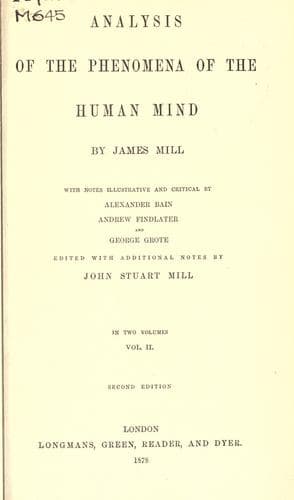
Analysis of the Phenomena of the Human MindMill, James
PhilosophyPhilosophy
Analysis of the Phenomena of the Human Mind
Mill, James
Psychology
That the Predications of Geometry are of the same nature with those
of Arithmetic, is a truth of the greatest importance, and capable of
being established by very obvious reasoning. It is well known, that
all reasoning about quantity can be expressed in the form of
algebraic equations. But the two sides of an algebraic equation are
of necessity two marks or two names for the same thing; of which the
one on the right-hand side is more distinct, at least to the present
purpose of the inquirer, than the one on the left-hand side; and the
whole purpose of an algebraic investigation, which is a mere series
of changes of names, is to obtain, at last, a distinct name, a name
the marking power of which is perfectly known to us, on the
right-hand side of the equation. The language of geometry {191}
itself, in the more simple cases, makes manifest the same
observation. The amount of the three angles of a triangle, is twice
a right angle. I arrive at this conclusion, as it is called, by a
process of reasoning: that is to say, I find out a name "twice a
right angle," which much more distinctly points out to me a certain
quantity, than my first name, "amount of the three angles of a
triangle;" and the process by which I arrive at this name is a
successive change of names, and nothing more; as any one may prove
to himself by merely observing the steps of the demonstration.[57]
[Editor's footnote 57: I cannot see any propriety in the expression
that when we infer the sum of the three angles of a triangle to be
twice a right angle, the operation consists in finding a second name
which more distinctly points out the quantity than the first name.
When we assent to the proof of this theorem, we do much more than
obtain a new and more expressive name for a known fact; we learn a
fact previously unknown. It is true that one result of our knowledge
of this theorem is to give us a name for the sum of the three
angles, "the marking power of which is perfectly known to us:" but
it was not for want of knowing the marking power of the phrase "sum
of the three angles of a triangle" that we did not know what that
sum amounted to. We knew perfectly what the expression "sum of the
three angles" was appointed to mark. What we have obtained, that we
did not previously possess, is not a better mark for the same thing,
but an additional fact to mark the fact which is marked by
predicating of that sum, the phrase "twice a right angle."--_Ed._]
Public-domain text, read in full here on John Shaqi.
Reviews
Reviews
No reviews yet
Be the first to share your thoughts on this work.
Elsewhere in the archive
Join the Discussion
Join the discussion
Sign in to leave a comment or review.
Sign InorCreate an account