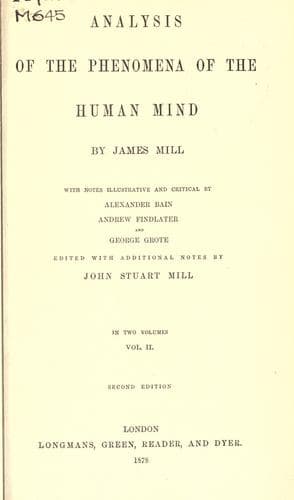
Analysis of the Phenomena of the Human MindMill, James
PhilosophyPhilosophy
Analysis of the Phenomena of the Human Mind
Mill, James
Psychology
{198} The Interrogative is easily explained. It is merely the
Relative, in a very elliptical form of expression. The interrogative
sentence, "_Who_ gave you that book?" when the subaudition is
supplied, is thus expressed: The person gave you the book, _and him_
I will you to name to me. "_What_ is the hour of the day?" is an
elliptical form of,--It is an hour of the day, _and it_ I will you
to tell me.
{199} SECTION VI.
ADVERBS.
The power of this class of words, in the great business of marking,
and the extent of the service rendered by them, will be so easily
seen, that a few words will suffice to explain them. Adverbs may be
reduced under five heads; 1, Adverbs of Time; 2, Adverbs of Place;
3, Adverbs of Quantity; 4, Adverbs of Quality; 5, Adverbs of
Relation. They are mostly abridgments, capable of being substituted
for longer marks. And they are always employed for the purpose of
putting a modification upon the Subject, or the Predicate, of a
Proposition. A few examples will suffice for the further elucidation
of this subject. "Anciently," is an adverb of time. It is of the
same import as the expression, "In distant past time." It is applied
to modify the subject, or predicate, of a proposition, as in the
following example: "A number of men anciently in England had wives
in common." "Had wives in common," is the predicate of the above
proposition, and it is modified, or limited, in respect to time, by
the word "anciently." Adverbs of place it is easy to exemplify in
the same manner. Under adverbs of quantity all those which mark
degrees may be included; as greatly, minutely: Thus, "He enlarged
greatly upon patriotism:" "Greatly" here means "in many words;" and
it modifies the predicate, "enlarged," &c. Adverbs of {200} quality
and relation are exceedingly numerous, because they are easily made
from the words which connote the quality or relation: thus, from
hard, hardly; from loud, loudly; from sweet, sweetly; from warm,
warmly: again, from father, paternally; from son, filially; from
magistrate, magisterially; from high, highly; from expensive,
expensively; and so on. In all this no difficulty is presented which
requires removing.[60]
[Editor's footnote 60: In many cases, and even in some of the
examples given, the adverb does not modify either the subject or the
predicate, but the application of the one to the other. "Anciently,"
in the proposition cited, is intended to limit and qualify not men,
nor community of wives, but the practice by men of community of
wives: it is a circumstance affecting not the subject or the
predicate, but the predication. The qualification of past and
distant time attaches to the fact asserted, and to the copula, which
is the mark of assertion. The reason of its seeming to attach to the
predicate is because, as the author remarked in a previous section,
the predicate, when a verb, includes the copula.--_Ed._]
{201} SECTION VII.
PREPOSITIONS.
Public-domain text, read in full here on John Shaqi.
Reviews
Reviews
No reviews yet
Be the first to share your thoughts on this work.
Elsewhere in the archive
Join the Discussion
Join the discussion
Sign in to leave a comment or review.
Sign InorCreate an account