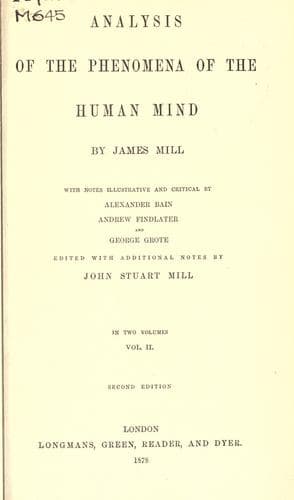
Analysis of the Phenomena of the Human MindMill, James
PhilosophyPhilosophy
Analysis of the Phenomena of the Human Mind
Mill, James
Psychology
In the second of the two examples, "_Unless_ the ship had been well
manned, it would have been lost," the contrivance is the same, with
a mere change of position. _Unless_, is a word of the same import,
rather the same word, as _else_. _Unless_ is PREFIXED to the
_conditioning_ predication, whereas _else_ is SUFFIXED; and that is
the difference.[67] The word _except_, which signifies _take_ {219}
_away_, may be substituted for _unless_. A peculiar application of
_if_ (_give_) may here also be exemplified. _If_ with the negative,
(_if not_,) has a similar signification with unless, except; "_If_
the ship had not been well manned, &c."
[Findlater's footnote 67: _Unless_ is simply _on less_,
corresponding to Fr. _à moins_, and is equivalent to _if
not_.--_F._]
Let us now pass to another case.
"_Although_ the ship was well manned, it was lost." The two
predications may change places, without change of meaning. "The ship
was lost, _although_ it was well manned."
What (as above) was to be marked by _else_, _unless_, _if not_,
_except_, and so on, was the connexion between a cause and its usual
effect; that is, the manning of a ship, and the safety of the ship.
What is to be marked in this case is the want of connexion between a
cause and its usual effect. It is done by similar means.
_Although_ is part of an obsolete verb, _to allow_, _to grant_.[68]
The two predications are: "The ship was well manned," "The ship was
lost." I want to mark between my two predications not only a
connexion, that of the antecedence and consequence of the predicated
events, but the existence of a consequent differing from that by
which the antecedent is usually followed. _Although_, prefixed to
the predication of the antecedent event, gives notice of another
predication, that of the consequent, and of a consequent differing
from that by which the antecedent might have been {220} followed:
_Grant_ such an antecedent, such and not such was the consequent.
[Findlater's footnote 68: _Although_ is a compound pronominal adverb
resembling Lat. _tamen_, and means "(the case being) quite thus
(yet)."--_F._]
The same connection is marked by other conjunctions. "The ship was
well manned, _nevertheless_ it was lost." _Nevertheless_, means _not
less for that_.[69] "_Notwithstanding_ the ship was well manned, it
was lost." _Notwithstanding_, is, _not being able to prevent_,
_maugre_, _in spite of_. The resolution of the above sentences is
obvious. "The ship was well manned, _yet_ it was lost." _Yet_ is the
verb _get_, and has here the force of _although_, _grant_. "The ship
was well manned, _yet_ (or got, that being got, had, granted) it was
lost."[70] "The ship was well manned, _still_, it was lost." _Still_
is part of an obsolete verb, _to put_, _to fix_, _to establish_.
"The ship was well manned, _still_ (that put, that supposed) it was
lost."[71]
Public-domain text, read in full here on John Shaqi.
Reviews
Reviews
No reviews yet
Be the first to share your thoughts on this work.
Elsewhere in the archive
Join the Discussion
Join the discussion
Sign in to leave a comment or review.
Sign InorCreate an account