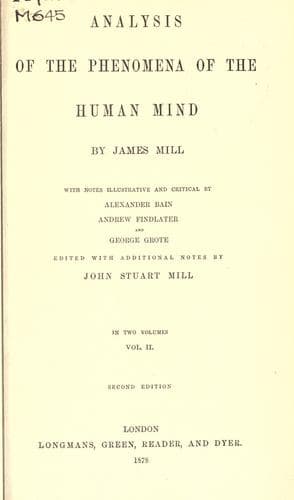
Analysis of the Phenomena of the Human MindMill, James
PhilosophyPhilosophy
Analysis of the Phenomena of the Human Mind
Mill, James
Psychology
{223} CHAPTER V.
CONSCIOUSNESS.
"It is not easy for the mind to put off those confused notions and
prejudices it has imbibed from custom, inadvertency, and common
conversation. It requires pains and assiduity to examine its ideas,
till it resolves them into those clear and distinct simple ones out
of which they are compounded; and to see which, amongst its simple
ones, have or have not a necessary connexion and dependence one upon
another. Till a man doth this in the primary and original notions of
things, he builds upon floating and uncertain principles, and will
often find himself at a loss."--_Locke_, _Hum. Und._ b. ii. c. 13.
s. 28.
IT will now be instructive to retrace our steps, to look back upon
the space we have passed, and contemplate the progress we have made
toward our journey's end.
We have become acquainted with the elementary feelings of our
nature; _first_, those derived immediately from our bodies, whether
by impressions made on the surface of them, or unseen causes
operating on them within; _secondly_, the feelings which, after the
above mentioned feelings have ceased, are capable of existing as
copies or representatives of them.
We have also observed the manner in which those _secondary_
Feelings, to which we have given the name of IDEAS, flow, either
into _groups_, or into _trains_. And {224} we have explored the
system of contrivances, to which mankind have had recourse, for
MARKING those feelings, and the trains of them; so as either to fix
the knowledge of them for one's own use, or to make communication of
them to others.
In what has been thus already presented, it will be seen that
several expositions of considerable importance are included.
Sensations, and Ideas, are both feelings. When we have a sensation
we feel, or have a feeling; when we have an idea we feel, or have a
feeling.
Having a SENSATION, and having a feeling, are not two things. The
thing is one, the names only are two. I am pricked by a pin. The
sensation is one; but I may call it sensation, or a feeling, or a
pain, as I please. Now, when, having the sensation, I say I feel the
sensation, I only use a tautological expression: the sensation is
not one thing, the feeling another; the sensation is the feeling.
When, instead of the word feeling, I use the word conscious, I do
exactly the same thing, I merely use a tautological expression. To
say I feel a sensation, is merely to say I feel a feeling; which is
an impropriety of speech. And to say I am conscious of a feeling, is
merely to say that I feel it. To have a feeling is to be conscious;
and to be conscious is to have a feeling. To be conscious of the
prick of the pin, is merely to have the sensation. And though I have
these various modes of naming my sensation, by saying, I feel the
prick of a pin, I feel the pain of a prick, I have the sensation of
a prick, I have the feeling of a prick, I am conscious of the
feeling; the thing named in all these various ways is one and the
same.
Public-domain text, read in full here on John Shaqi.
Reviews
Reviews
No reviews yet
Be the first to share your thoughts on this work.
Elsewhere in the archive
Join the Discussion
Join the discussion
Sign in to leave a comment or review.
Sign InorCreate an account