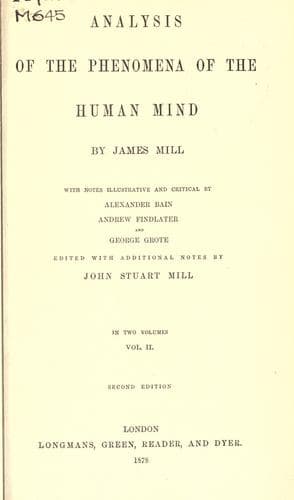
Analysis of the Phenomena of the Human MindMill, James
PhilosophyPhilosophy
Analysis of the Phenomena of the Human Mind
Mill, James
Psychology
It is thus to be seen, that appellatives, or general names, are
significant, in two modes. We have frequently had occasion to recur
to the mode in which the simple ideas of sensation are associated or
concreted, so as to form what we call the complex ideas of objects.
Thus, I have the complex ideas of this pen, this desk, this room,
this man, this handwriting. The simple ideas, so concreted into a
complex idea in the case of each individual, are one thing signified
by each appellative; and this complex idea of the individual,
concreted with another, and another of the same kind, and so on
without end, is the other of the things which are signified by it.
Thus, the word rose, signifies, first of all, a certain odour, a
certain colour, a certain shape, a certain consistence, so
associated as to form one idea, that of the individual; next, it
signifies this individual associated with another, and another, and
another, and so on; in other words, it signifies the class.
The complexity of the idea, in the latter of the two cases, is
distinguished by a peculiarity from that of the former. In applying
the name to the odour, and colour, and so on, of the rose, concreted
into one idea, the name is not the name of each of the sensations
taken singly, only of all taken together. In applying the name to
rose, and rose, and rose, without end, the name is at once a name of
each of the individuals, and also the name of the complex
association which is formed of them. This too, is itself a peculiar
association. It is not the association of a name with a number of
particulars clustered together {267} as one; but the association of
a name with each of an indefinite number of particulars, and all
those particulars associated back again with the name.
This peculiarity may require a little further explanation. It is
well known, that between an idea, and the name which stands for it,
there is a double association. The name calls up the idea in close
association, and the idea calls up the name in equally close
association; and this they have a tendency to do in a series of
repetitions; the name bringing up the idea, the idea the name, and
then the name the idea again, and so on, for any number of times.
This is, in great part, the way in which language is learned, as we
observe by the repetitions to which children are prone. And this,
indeed, is what, in many cases, we mean when we speak of dwelling
upon an idea. It is a familiar observation, that no idea dwells in
the mind, or can; for it has innumerable associations, and whatever
association occurs, of course, displaces that by which it is
introduced. But if the idea which thus displaces it, again calls it
up, and these two go on calling up one another, that which is the
more interesting of the two appears to be that which alone is
occupying the attention. This alternation is frequent between the
name and the idea.
Public-domain text, read in full here on John Shaqi.
Reviews
Reviews
No reviews yet
Be the first to share your thoughts on this work.
Elsewhere in the archive
Join the Discussion
Join the discussion
Sign in to leave a comment or review.
Sign InorCreate an account