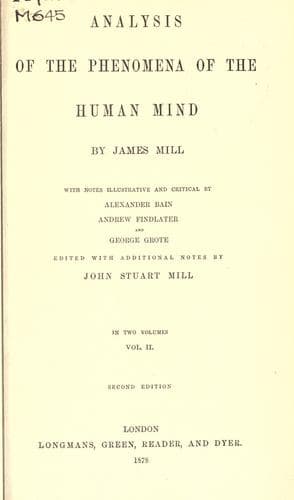
Analysis of the Phenomena of the Human MindMill, James
PhilosophyPhilosophy
Analysis of the Phenomena of the Human Mind
Mill, James
Psychology
If this mode of using the terms is more consonant to propriety of
language, so also is it more scientifically convenient. It is of
extreme importance to have a technical expression exclusively
consecrated to signify the peculiar mode in which the name of a
class marks the attributes in virtue of which it is a class, and is
called by the name. The verb "to note," employed by the author of
the Analysis as the correlative of "to connote," is far too general
to be confined to so specific a use, nor does the author intend so
to confine it. "To connote," on the contrary, is a phrase which has
been handed down to us in this restricted acceptation, and is
perfectly fitted to be used as a technical term. There is no more
important use of a term than that of fixing attention upon something
which is in danger of not being sufficiently taken notice of. This
is emphatically the case with the attribute-signification of the
names of objects. That signification has not been seen clearly, and
what has been seen of it confusedly has bewildered or misled some of
the most distinguished philosophers. From Hobbes to Hamilton, those
who have attempted to penetrate the secret of the higher logical
operations of the intellect have continually missed the mark for
want of the light which a clear conception of the connotation of
general names spreads over the subject. There is no fact in
psychology which more requires a technical name; and it seems
eminently desirable that the words Connote and Connotative should be
exclusively employed for this purpose; and it is for this purpose
that I have myself invariably employed them.
In studying the Analysis, it is of course necessary to bear in mind
that the author does not use the words in this sense, but sometimes
in a sense much more vague and indefinite, and, when definite, in a
sense the reverse of this. It may seem an almost desperate
undertaking, in the case of an unfamiliar term, to attempt to
rectify the usage introduced by the actual reviver of the word: and
nothing could have induced me to attempt it, but a deliberate
conviction that such a technical expression is indispensable to
philosophy, and that the author's mode of employing these words
unfits them for the purpose for which they are needed, and for which
they are well adapted. I fear, however, that I have rarely succeeded
in associating the words with their precise meaning, anywhere but in
my own writings. The word Connote, not unfrequently meets us of late
in philosophical speculations, but almost always in a sense more lax
than the laxest in which it is employed in the Analysis, meaning no
more than to imply. To such an extent is this the case, that able
thinkers and writers do not always even confine the expression to
names, but actually speak of Things as connoting whatever, in their
opinion, the existence of the Things implies or presupposes.--_Ed._]
Public-domain text, read in full here on John Shaqi.
Reviews
Reviews
No reviews yet
Be the first to share your thoughts on this work.
Elsewhere in the archive
Join the Discussion
Join the discussion
Sign in to leave a comment or review.
Sign InorCreate an account