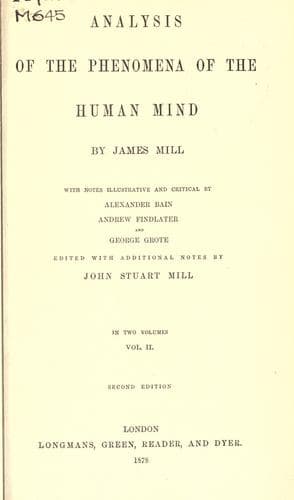
Analysis of the Phenomena of the Human MindMill, James
PhilosophyPhilosophy
Analysis of the Phenomena of the Human Mind
Mill, James
Psychology
The noticeable thing however is that if _a_ stands merely for the
sensation, _x_ really is a little more than _a_: the connotation (in
the author's sense of the term) of the concrete name is not _wholly_
dropped in the abstract name. The term blackness, and every other
abstract term, includes in its signification the existence of a
black object, though without declaring what it is. That is indeed
the distinction between the name of an attribute, and the name of a
kind or type of sensation. Names of sensations by themselves are not
abstract but concrete names. They mark the type of the sensation,
but they do not mark it as emanating from any object. "The sensation
of black" is a concrete name, which expresses the sensation apart
from all reference to an object. "Blackness" expresses the same
sensation with reference to an object, by which the sensation is
supposed to be excited. Abstract names thus still retain a limited
amount of connotation in both the author's senses of the term--the
vaguer and the more specific sense. It is only in the sense to which
I am anxious to restrict the term, that any abstract name is without
connotation.
An abstract name, then, may be defined as the name of an attribute;
and, in the ultimate analysis, as the name of one or more of the
sensations of a cluster; not by themselves, but considered as part
of any or all of the various clusters, into which that type of
sensations enters as a component part.--_Ed._]
{305} It hence, also, appears that there can be no ABSTRACT term
without an implied CONCRETE, though cases are not wanting, in which
there is much occasion for the ABSTRACT term but not much for the
CONCRETE; in which, therefore, the concrete is not in use, or is
supplied by another form of expression.
{306} In regular and capricious languages, as our own, the dropping
of the connotation of the concrete terms is not marked in a uniform
manner; and this requires some illustration. Thus, heavy is a
concrete term, and we shew the dropping of the connotation, by the
same mark as in the instances above, saying heaviness; but we have
another term which is exactly the equivalent of heaviness, and
frequently used as the abstract of heavy; that is, weight. Friend is
a concrete, connotative term, in the substantive form. Its
connotation is dropped by another mark, the syllable ship; thus,
friendship; in like manner, generalship; brothership; cousinship.
The syllable age is another of the marks we use for the same
purpose; pilotage, parsonage, stowage.
Public-domain text, read in full here on John Shaqi.
Reviews
Reviews
No reviews yet
Be the first to share your thoughts on this work.
Elsewhere in the archive
Join the Discussion
Join the discussion
Sign in to leave a comment or review.
Sign InorCreate an account